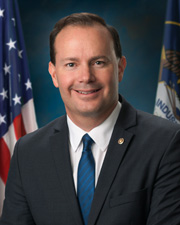
Mike LEE
Republican · Utah
Ranked #3 of 100 senators
Total Score960
Actions20
Avg/Action48.0
Era Comparison
Biden Term
Jan 2021 - Jan 2025
Score915
Actions19
Avg48.2
Trump 2nd Term
Jan 2025 - Present
Score45▼ 95%
Actions1
Avg45.0
Tactics Breakdown
UC OBJECTION1 actions (45 pts)
Action History
Loading filters...
Wed, May 21, 2025
UC OBJECTION45
H.R. 22, the SAVE Act - unanimous consent request for immediate consideration and passage
Senator Padilla reserves the right to object to Senator Lee's unanimous consent request to immediately consider and pass H.R. 22, indicating he will likely object and prevent the expedited passage of this legislation.
View floor text
Madam President, we need to remember a couple of things. First, when someone has gone through the process of immigrating to the United States, they have completed a journey--perhaps a lengthy odyssey--of moving to the United States, applying for and ultimately obtaining U.S. citizenship. They have provided a lot of documentation. They have done a lot of things to make that happen. And it would be an insult to those who are U.S. citizens, whether natural-born or naturalized citizens, to make it easy for people to cheapen that, to undermine it, to dilute that by coming in and saying: You know, I am filling out my driver's license application, and all I have to do here is check a box--check a box, sign my name saying, yes, I am a U.S. citizen. Well, you know, that is not an option in other areas where citizenship is required. It is absolutely not an option, for example, in applying for a passport, which is one of the documents that can be provided and often is provided when someone completes the process of filling out an I-9 and thereby establishing their work eligibility as a U.S. citizen. One of the forms that they can provide to help establish that is a U.S. passport. But regardless of what combination of identification they use, they do have to establish their citizenship. Why? Well, because that is the law. There are very good reasons why we have those laws in place to make sure that, when someone starts a job, they are either a U.S. citizen or they have a visa with some type of work authorization in it. So it makes zero sense, for something as significant and important to the very foundations of our constitutional Republic as the right to vote, that we could just so lightly cast aside the need to verify citizenship when we go out of our way in other contexts, like starting a new job, to make sure that they prove it. So, sure. My friend and colleague points out, when people fill out that driver's license application, they do have to check that box, and they do have to sign their name, but why make it so that someone could lie, especially when read against the backdrop of the Supreme Court ruling 12 years ago, concluding--wrongly, in my view but concluding nonetheless, and that decision is on the books--that not only do they not have to prove citizenship, but no State official, when receiving the driver license application form, may even inquire, even if they have reasons to doubt that the person has committed something or otherwise--they can't ask, even if there has been a wave in that State or in that area or across the country of noncitizens registering to vote and that State wants to make a decision--you know, we really ought to provide some degree of documentation--they are not allowed to do any of that. So this is filling that gap, and it is important to do that. To that end, Madam President, notwithstanding rule XXII, I ask unanimous consent that the Senate proceed to the immediate consideration of H.R. 22, the SAVE Act, which is at the desk. I further ask unanimous consent that the bill be considered read a third time and passed and that the motion to reconsider be considered made and laid upon the table. The PRESIDING OFFICER. Is there objection? The Senator from California. Mr. PADILLA. Madam President, reserving the right to object, I reserve the right to object not for the first time on this proposed SAVE Act, not even for the second time on this proposed SAVE Act. This is an item that my colleague has brought up repeatedly here before the Senate. So I won't repeat the arguments and explanations that I have made in prior objections to the SAVE Act but to suggest it is a solution in search of a problem. Audit after audit, review after review, investigation after investigation has demonstrated that the instances of ineligible immigrants voting in elections is exceedingly, exceedingly, exceedingly rare, which, again, means that our current laws are working. And to suggest that birth certificates be required for a certain task when it is already secure--we could have--I would be walking around with my birth certificate in my pocket. A passport is another acceptable form of documentation for citizenship. Half the American public doesn't have a current, valid passport because not everybody travels abroad on a regular basis. So they are unnecessary. Our current laws are working, and, therefore, I object. The PRESIDING OFFICER. The objection is heard. The Senator from Utah. Mr. LEE. Madam President, with great respect to my friend and colleague the distinguished senior Senator from California, he has suggested that the SAVE Act, which merely requires some type of proof of citizenship when someone registers to vote in U.S. elections--that the SAVE Act itself is a solution in search of a problem. My friend also suggests that no documentary proof of citizenship is or should be made necessary, even considering the Supreme Court's ruling that States are not even allowed to request such documentation where they may deem it necessary. He suggests that this is the case because, as he puts it, the occurrence of noncitizens voting in U.S. elections is not only rare, but it is exceedingly, exceedingly, exceedingly rare, as he puts it. I don't know exactly what that means, but I do know that, taken to its logical conclusion, that same logical leap could and would lead us to all kinds of outcomes that we would never dream of. There are all sorts of things that may be rare by some standard or another. Sure, it is true that most of the people voting in U.S. elections are not noncitizens. In fact, I would say that they would be a small, small, small minority of those casting votes because most people here in the United States, most people voting in U.S. elections, are, in fact, U.S. citizens. But taken to its logical conclusion, that would suggest that there is no need for TSA, which, actually, I would be fine with for all sorts of reasons. But taken to its logical conclusion, it would suggest there is no need for you to identify yourself when you go through TSA because instances of terrorism are exceedingly rare or instances of people boarding an airplane in somebody else's name are exceedingly rare. Sure, that happens. Taken to its logical conclusion, it would also suggest that because instances of people starting a job, beginning employment in the United States as an American citizen or as a noncitizen pretending to be an American citizen, are exceedingly, exceedingly, exceedingly rare, as he puts it, therefore we should require no documentary evidence of either U.S. citizenship on one hand or work eligibility with a visa on the other hand. I could go on and on. But it is not an answer to the need for the SAVE Act, to the demand that 80-plus percent of the American people agree with, which is noncitizens shouldn't vote in U.S. elections. It is not an answer to that demand, to that widely held bipartisan supermajority view, not an answer to that to suggest that because noncitizen voting is rare, we need not require any proof of citizenship ever. Why? Well, there are so many reasons why, but here is the simplest one. When we make that easy, more people would do it. Some elections are decided by large margins; others are decided by, to use his words, exceedingly, exceedingly, exceedingly small margins. We would be doing ourselves and the American people and the American Republic and the U.S. Constitution a grave, grave disservice if we didn't take that risk very seriously. Foreign election interference and meddling in our system is a real threat. We need to take it seriously. It is tragic and unfortunate. In fact, it is shameful that we haven't passed the SAVE Act. This is not the end of this issue. I will be back. We will get this passed. But between now and whenever we do get it passed, the American people are taking on a risk because of this body's unwillingness to act. And it is not this body. Let's face it. It is Members of this body on one side of the aisle, and not on the other, who are willing to incur this risk. That, tragically, is a sacrifice they are willing to make. We, tragically, are a sacrifice they are willing to make. Let's not let them continue to make it. Let's pass the SAVE Act. (Mr. MORENO assumed the Chair.) The PRESIDING OFFICER (Mr. Marshall). The Senator from Vermont. Unanimous Consent Request--S. Res. 224