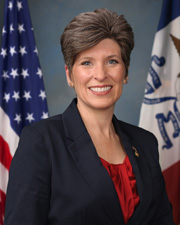
Joni ERNST
Republican · Iowa
Ranked #41 of 100 senators
Total Score120
Actions4
Avg/Action30.0
Era Comparison
Biden Term
Jan 2021 - Jan 2025
Score75
Actions3
Avg25.0
Trump 2nd Term
Jan 2025 - Present
Score45▼ 40%
Actions1
Avg45.0
Tactics Breakdown
UC OBJECTION1 actions (45 pts)
Action History
Loading filters...
Fri, May 9, 2025
UC OBJECTION45
Casey Mulligan nomination for SBA Chief Counsel of Office of Advocacy
Senator Markey reserves the right to object to a unanimous consent request for confirming a nomination, which will delay the confirmation and force extended debate on the matter.
View floor text
Mr. President, I rise today to seek unanimous consent to confirm Casey Mulligan, the President's nominee to be the chief counsel of the Office of Advocacy at the Small Business Administration. I will make that motion in just a moment, but first, let me explain why I am doing this. This week is National Small Business Week, a week to recognize the achievements of our Nation's entrepreneurs. As chair of the Small Business Committee, I have a front row seat to the successes and challenges of our small business owners, and I have the privilege of being a champion for Iowa entrepreneurs. Our small businesses are more vulnerable to burdensome government regulations. Over the past few years, the cost of regulations for small businesses has been out of control. The previous administration created more than 1,100 final rules costing $1.8 trillion. The Biden administration's regulatory costs were 600 times higher than that of the first Trump administration and 3.7 times higher than that of the Obama administration. I have been encouraged by President Trump's efforts to freeze and roll back regulations. SBA Administrator Loeffler and the White House are working hard to eliminate burdensome and unnecessary regulations, but to be truly effective, small businesses need a Senate-confirmed chief counsel to continue this mission. The Office of Chief Counsel for Advocacy has been vacant, without a Senate-confirmed occupant for nearly a decade. This key role ensures small business interests are protected. Having served as the top Republican on the Small Business Committee for years now, I truly understand the need for this position to be filled immediately, and we are fortunate that President Trump nominated a highly qualified individual for this role. Dr. Casey Mulligan's unique mix of academic success and real-world small business experience makes him the best candidate for the job. A Harvard graduate, Dr. Mulligan received his Ph.D. in economics from the University of Chicago where he currently serves as an economics professor. In addition to his academic role, Dr. Mulligan also owns two small consulting and economic research businesses. He has also conducted extensive research on the economic effects of regulation on small businesses. At the SBA Office of Advocacy, Dr. Mulligan would serve as a champion for small businesses nationwide as the Agency undergoes much needed changes to policy and direction. Advocacy's role remains true regardless of party, to ensure that a strong chief counsel stands up for the little guy and warns regulators when small firms will be harmed. Dr. Mulligan understands Main Street and the importance of examining all costs imposed on America's entrepreneurs. I urge my colleagues to consent to the confirmation of Dr. Mulligan as chief counsel of the Office of Advocacy at the SBA. I ask unanimous consent that the Senate proceed to executive session to consider the following nomination, Calendar No. 59; that the Senate vote on the nomination without intervening action or debate; that the motion to reconsider be considered made and laid upon the table and that the President be immediately notified of the Senate's action and the Senate resume legislative session. The PRESIDING OFFICER. Is there objection? Mr. MARKEY. Reserving the right to object. The PRESIDING OFFICER. The Senator from Massachusetts. Mr. MARKEY. Mr. President, I would like to speak on this motion to confirm Casey Mulligan to be chief counsel of the Office of Advocacy. In the last 3\1/2\ months, we have seen an unprecedented assault by the Trump administration on America's small businesses. Elon Musk and DOGE have taken a chain saw to SBA. They have done away with 43 percent of its staff and an estimated 2,700 people, and I say ``estimated'' because SBA won't share who has been fired and who has been retained with the public or with the U.S. Senate. We don't know. We requested a meeting with DOGE in February and have yet to hear back. The little we do know about what DOGE is doing at SBA is gleaned through media reports rather than through their responses to our congressional requests. Because of this administration's utter contempt for accountability and its shameless lack of transparency, we don't know if SBA has sufficient staff on hand to carry out its day-to-day operations. We don't know which congressionally authorized and funded programs have been illegally shut down. We don't know which SBA field offices will remain open to serve small business owners where they live and work. And yet, the Senate Republicans want us to rubberstamp their slash-and-burn tactics and confirm this SBA nominee by unanimous consent with a total disregard from the Trump administration to tell the U.S. Senate what is going on inside of the SBA. They have the SBA inside one big ``witness protection program.'' We can't get them to tell us anything about anything. And they want us to come out here by unanimous consent and to start to confirm appointees to the SBA to further dismantle programs that are essential to small businesses all across our country? And let me say this: My Republicans do not see how the Trump administration is turning Main Street into ``Pain Street,'' and it is in their home States. Small businesses are being forced to absorb skyrocketing costs because of President Trump's destructive tariffs. They are terrified of losing customers, as consumer confidence levels take a historic nosedive. They are listening with shock and disbelief. Small businessmen and women across the country have to have their bottle of Pepto Bismol right next to them every single day, not knowing what the impact is going to be of the Trump tariffs on their small businesses across the country. And by the way, there are 34 million of those small businesses right now, and we have got a Small Business Administration that won't even talk to the U.S. Senate, much less to those small business people who are terrified right now. They, right now, are terrified. They are shocked, as President Trump tells American consumers that they are going to pay luxury prices to shop at mom-and-pop shops in the United States. Does anyone in this administration understand the harm they are causing to small businesses? I can tell you at least one entity that does: the U.S. Chamber of Commerce. Last week, the U.S. Chamber of Commerce called on the Trump administration to develop a tariff exclusion process to prevent irreparable harm to small businesses and to stop the country from falling into a recession. The U.S. Chamber is speaking on behalf of chambers of commerce all across this country--every city and town. They are speaking for them. They are saying: Protect small businesses from the Trump tariffs. That is the U.S. Chamber of Commerce. That is what we should be debating out here on the floor right now--a bill to protect all small businesses from the Trump tariffs. Instead, we are talking about confirming someone who absolutely should not be debated on the Senate floor at this time, because those little businesses don't have the protections that big companies with big margins have. They are very, very vulnerable, and Casey Mulligan, the nominee for Chief Counsel for Advocacy, has actually questioned the value of longstanding and widely expected worker protections, including sick leave and paid healthcare and the right to unionize. And, not surprisingly, not a single Democrat on the Small Business Committee voted to advance his nomination. So this is not the right time, and he is not the right person to have this job. Confirming Dr. Mulligan will only further President Trump's radical, damaging attack on small businesses and their workers. And with that, I object. The PRESIDING OFFICER. The objection is heard. S.J. Res. 7 Mr. VAN HOLLEN. Mr. President, I rise in strong opposition to today's resolution to overturn an FCC rule that provides greater flexibility to ensure that every student has the access to the internet that they need. We have known for a long time that internet access is critical for education. Students need Wi-Fi to connect with classmates and teachers, work on group projects, do research, and even just hit the ``submit'' button on some assignments. Yet too many Americans can't access reliable internet at home. It is called the ``homework gap,'' and it is leaving thousands of kids behind. This disparity only worsened during the pandemic, when the homework gap became a full learning gap for thousands of students. Many kids without internet at home had to sit in McDonald's parking lots so they could Zoom into class. As part of the American Rescue Plan, I worked with my colleague from Massachusetts Senator Ed Markey and former FCC Chairwoman Rosenworcel to launch the Emergency Educational Connectivity Fund, or ECF. This $7 billion program provided nearly 18 million students at over 10,000 schools and libraries with hotspots, routers, and other equipment for students and educators to connect to the internet at home. Maryland schools and libraries received over $145 million through this program to help bridge the homework gap in my State. Even as we worked to provide support for students on an emergency basis, we worked with the FCC on modernization of the E-Rate program to ensure it meets student needs. The new FCC rule allows schools and libraries to loan out Wi-Fi hotspots to students and educators at home so we can continue to address the homework gap. But now, the Republicans want to repeal this commonsense reform and take away hotspots from low-income and rural families. This is a backwards step at a time when access to the internet is more important than ever. And because the new rule simply allowed the use of existing E-Rate funds more flexibly, the repeal of this rule does not save a dime. A vote to repeal this rule is a vote to limit the FCC's ability to address a critical need for students and to put a stop to good work being done by schools and libraries to support learning. This was an issue before the pandemic and remains an issue today. We all know that access to the internet is essential. We have worked on a bipartisan basis to expand broadband access, but we have a long way to go. The FCC modernized E-Rate to ensure that students are not disadvantaged by lack of access to broadband at home, whether that is because they are in a rural area with no connection or because it is unaffordable for their parents. This is a commonsense measure, and I urge my colleagues to vote against its repeal today. The PRESIDING OFFICER. All time is expired. The clerk will read the title of the joint resolution for the third time. The joint resolution was ordered to be engrossed for a third reading and was read the third time. Vote on S.J. Res. 7