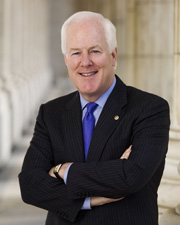
John CORNYN
Republican · Texas
Ranked #50 of 100 senators
Total Score90
Actions4
Avg/Action22.5
Era Comparison
Biden Term
Jan 2021 - Jan 2025
Score75
Actions3
Avg25.0
Trump 2nd Term
Jan 2025 - Present
Score15▼ 80%
Actions1
Avg15.0
Tactics Breakdown
EXTENDED DEBATE1 actions (15 pts)
Action History
Loading filters...
Wed, September 10, 2025
EXTENDED DEBATE15
Democratic blocking of Trump nominees leading to contemplated nuclear option
This is a lengthy speech criticizing Democratic obstruction of nominees and building case for the 'nuclear option' to override parliamentary rules, but the speech itself is routine floor debate rather than an obstructive tactic.
View floor text
Mr. President, I want to begin by thanking our colleagues--particularly from Oklahoma and Alabama--for leading the working group that was appointed by the majority leader to try to solve this problem. In their typical deliberative, careful, and thoughtful fashion, they could have come up with a lot of ideas that would, I think, perhaps overreach, but rather than do that, they have come up with a solution that Democrats themselves have proposed, which strikes me as the epitome of fairness. But there are three main points I want to make before I sort of summarize where I think we are. First of all, as my colleagues have eloquently noted, we have exhausted virtually every other alternative to this vote to overrule the Parliamentarian and establish a new precedent, which is an alternative to a formal rule change which takes 67 votes. But we know our colleagues will never vote for that, leaving us no alternative but to invoke what is sometimes called the nuclear option. But as our colleague from Missouri just pointed out, this is really not so much a nuclear option as a restoration option. This is restoring the Senate to the way it used to work--not just before President Trump was reelected but for the last couple of hundred years, where we had an orderly process to consider a President's nominees, a committee process to vet them, and then a debate and a vote on the Senate floor, so that the mandate of the voters in the Presidential election could be carried out by the President. So we have tried virtually everything else, but I am going to give them one last chance here in a minute, but then as I have been thinking about it: What have we been doing as we have spent hour upon hour, day upon day, week upon week trying to move through all of these various Senate-confirmed nominees, with no help--not just no help but with active obstruction--from our Democratic colleagues? I think about all of the other things that we could be working on-- even together--bipartisan solutions to our Nation's biggest problems and challenges. Economists call that opportunity cost. In other words, when you are mired down in this mindless obstruction and blocking any nominee just because they happen to be nominated by President Trump, you are missing the opportunity to do other important things. I know all of my colleagues--all 100 of us--came here to, hopefully, do important things, and that has been the source of great consternation and disappointment, I know, to many of us. But then I think about the people who have been nominated by President Trump. I have had them tell me this is an honor of a lifetime--people who have enjoyed tremendous success in business or in their professional lives to then give all that up in order to serve their country. These are patriots, and it is profoundly unfair to them, to their families, and to the American people to continue to block these nominees and leave them, basically, hanging in the wind. I have talked to many of them myself, these nominees, with their asking: Senator, when can I expect a vote on the Senate floor? I say: Well, I don't know. Many of them have said: Well, I have had to quit my job or sell my business. I have had to go through a rigorous vetting process for ethics and legal conflicts of interest and I am waiting and my family is waiting, not knowing whether we will be going to, maybe, an Embassy somewhere around the world or serving in some other important position here in Washington, DC, in the Trump administration. So this is profoundly unfair to them. And we wonder whether we are having a hard time getting good people to want to serve in government. Well, thankfully, there are still people who are willing to do it, despite the way they get treated when they are nominated. Thank goodness there are still good people who want to serve. Our Nation depends on it. But just to summarize, more than 140 of President Trump's nominees are waiting to be voted on as we speak. I don't know how you argue the converse of what I feel to be the case, which is the President won the election on November 5, and he is entitled to his team. He is at least entitled to an up-or-down vote on the nominations, and the American people are the ones who actually gave him that mandate. This is a kick in the teeth, a punch in the gut to those voters who voted for President Trump in this last election, expecting that he would bring change to Washington, DC, but he can't accomplish that mandate without his team. As we have heard, Senate Democrats are now engaged in an unprecedented level of obstruction, preventing these nominees from being confirmed and burning up all the floor time when we are in session on waiting around to vote on these nominees, most of whom in the past would have been confirmed by a voice vote or some sort of an expedited process--by consent even--but not with Donald J. Trump as President. Democrats have taken a completely different approach in obstructing each and every one of his nominees. Most of these individuals are uncontroversial. I remember the other day, we were voting on the general counsel for advocacy for the Small Business Administration, and I asked myself: What is that? And, yes, maybe--just maybe--we should limit the number of Senate-confirmed positions. I think that might be a good exercise to go through and see: Are there people who currently require Senate confirmation for whom it really isn't necessary because they only serve for a short period of time under the leadership of, maybe, a member of the President's Cabinet who is Senate-confirmed? Under George Herbert Walker Bush and President Clinton, 98 percent of those nominees were confirmed by unanimous consent. Under George W. Bush and President Obama, 90 percent were confirmed by unanimous consent, which is no debate, no argument--just a unanimous consent request, without objection, so ordered. During President Trump's first term in office, only 65 percent were. So you can see the slide from 98 to 90 to 65. What we have also learned is what goes around comes around. With President Biden, his number was 57 percent, but that is a far cry from what we have seen in President Trump's second term, with zero--zero--of these noncontroversial nominees, patriots. They want nothing but to serve their country, but they are being denied that opportunity out of blind, partisan obstruction--mindless obstruction. The only way it can be explained, the Senator from Missouri mentioned, is with Trump derangement syndrome, and this is it in all of its ugly manifestations. There is no other explanation. Now, changing the Senate rules is not something we do lightly because we know what goes around comes around, but the truth is, Republicans are more than willing to live with the change in the rules when Democrats are in the majority, when there is a Democrat President, which someday there may well be. So we are acting on behalf of all Senators, of all Presidents, of all nominees, and the entire American people when we say something has to change, and we are going to change it this week. I know all of us would prefer to deal with this in some way other than overruling the Parliamentarian and invoking the so- called nuclear option, but we have exhausted all of the other possibilities, with one exception, perhaps. In a moment, I am going to propose a unanimous consent request on a resolution that would allow the majority leader to call up at least 10 nominees advanced out of the same committee to be considered for a vote en bloc, or all together. This is something very similar to that which the chairman of the Rules Committee, Senator Klobuchar from Minnesota, and Angus King, an Independent from Maine, had proposed in 2023. If Democrats were really interested in solving the problem, if they were really interested in restoring the Senate to its previous reputation as the world's greatest deliberative body, they wouldn't object; they would agree. It is their idea, but what remains to be seen is whether Senate Democrats will agree to their own proposal. If Senate Democrats will consent to this proposal which I will propound momentarily, which will allow the en bloc consideration of nominees, then we can avoid a rule change, but if they block this resolution, they will show their true colors. They will show that this is not about deliberation; that this is not about what is in the best interests of the American people; that this is not about genuine oversight--but that this is naked, partisan obstruction. It will then be clear to all of us across the country that Democrat objections to changing the rules have nothing--nothing--to do with preserving the institutional integrity of the Senate and more to do with their crusade against President Trump and the American people who elected him last November 5. We will see if Senate Democrats would prefer to continue their historic obstruction or whether they would consent to let us carry out the essential function of this Chamber to provide a vote. That is all we are asking for is a vote on the nominations. Mr. President, as if in legislative session, I ask unanimous consent that the Committee on Rules and Administration be discharged from further consideration of S. Res. 379 and that the Senate proceed to its immediate consideration; further, that the resolution be agreed to and that the motion to reconsider be considered made and laid upon the table with no intervening action or debate. The PRESIDING OFFICER. Is there an objection? The Senator from California. Mr. PADILLA. Mr. President, reserving the right to object. I have been listening to my colleague from Texas. The part that he said a couple of times over the last several minutes was that he was looking for some sort of explanation as to why Democrats are doing what we are doing. So let me attempt to respond to them. I can't help but observe that my colleague from Texas and Senate Republicans like to point out that Senate Democrats were proposing reforms to the nominations process in 2024--yes, just last year. That is not a secret. A formal proposal was introduced. The Senate Rules Committee, of which I was a member and am now serving as ranking member this session, held a public hearing on these issues just over a year ago. There have been bipartisan discussions about these issues going back years. Senate Democrats led a bipartisan effort in 2024 for changes that would take effect in 2025. Now, why are those dates important? Because these proposals were made back when the outcome of last year's Presidential election was unknown, like that is the ultimate fair way to do it. That is the way to get bipartisan support. These ideas are good or not good; you support them or you don't support them regardless of who is President or which party is in power. Unfortunately, Senate Republicans, at the time, showed little interest in these reforms, not just last summer but even late into 2024. I can't help but observe that, at the time, they were engaging in their own unprecedented obstruction and blockades of President Biden's nominees. One Senator, a Republican Senator, held up routine promotions at the Department of Defense for nearly a year--yes, I said the ``Department of Defense,'' by the way--and they were planning to use these same tactics if then-Vice President Harris had been elected President. But now that Donald Trump is back in the White House-- surprise, surprise--they are ready and set to make all of these changes immediately. The truth is, we shouldn't be in this situation. On that much, I guess, we do agree. But I am not just talking about the process. I am not just talking about the process. Since the beginning of the second Trump administration, this Senate has been faced with an unprecedented number of highly extreme and unqualified, unfit nominees, many nominees whose stated goal is to dismantle the Departments and Agencies and programs which they are being nominated to lead. Meanwhile, this administration is unlawfully impounding funds, firing people in droves, and abolishing Agencies created by Congress--actions that, if this Senate and Congress as a whole was living up to its responsibility as a separate but coequal branch of government, this branch is supposed to be providing oversight and accountability that is so lacking by the majority. Yet still, given all that, Senate Democrats have been willing to negotiate. We have been partners in good faith. There was even a bipartisan agreement on the table just before the August recess that we just returned from, a proposal that would expedite some of the less objectionable nominees. All the administration had to do was accommodate some reasonable requests--bipartisan requests, for that matter--from a number of Senators. Now, that is the normal process. Presidents and administrations of both parties have cooperated with Senators from both parties for decades to ensure the confirmation of nominees. But Trump rejected that option just weeks ago. The President himself told Leader Schumer and Senate Democrats to ``go to hell'' before the recess. Those three words are the perfect summary of how this President views Congress. It shows his contempt for Congress. That is why we are in this situation when it comes to his nominees, many, again, of whom are extreme and unfit in so many unprecedented ways. Talk about unprecedented. The way this administration is behaving is unprecedented. This is not normal. Now, it is clear that the President rejected a reasonable bipartisan agreement before the recess, and I appreciate my Republican colleagues' new interest in the 2024 proposal to reform the nomination process. So in that spirit of bipartisan cooperation, I think there is a very good chance that we can pass this with a very simple amendment to make the resolution effective January 20, 2029. Nobody here knows who the President will be then. Nobody knows which party will control the White House or be in the majority in this body by then. Nobody can predict it, and that is exactly the point. If the rule is good, then let's do it not knowing who is going to be in power when it takes effect. So I invite discussion and negotiation about the effective date in this resolution or, as my colleague from Texas suggested, maybe even revisiting the list of which nominees should require Senate confirmation. But this resolution doesn't even begin to discuss or address that. So as this resolution is currently drafted, it is unacceptable, and, therefore, I object. The PRESIDING OFFICER. The objection is heard. The Senator from Texas. Mr. CORNYN. Mr. President, of course, I am disappointed that our colleague from California is objecting on behalf of the Democrats in the Chamber, but I just want to summarize what I think I heard him say. First, Democrats are prepared to hold all these nominees hostage pending some sort of agreement. Well, you heard the Senator from Alabama, the Senator from Missouri, and the Senator from Oklahoma all talk about the endless discussions with individual members of the Senate Democrats, many of whom are sympathetic to the problem but were powerless to change it because the leadership--the minority leader, the Senator from New York--who controls that caucus would not hear of any sort of negotiation. We are all accustomed to negotiating around here. We do it on a daily basis. But we have tried, in good faith, every possible permutation, short of this action that we are taking today. But I have to ask, is it in good faith to say: Let's wait until 2029 to change the rules? What is President Trump supposed to do over the next 3 years? Govern with one arm tied behind his back, without the team that he has selected to help him govern the country? He won the election on last November 5. He got a mandate. People are sick and tired of the status quo here in Washington, DC. They want to see change. They want to see things shaken up. But now Democrats are saying: You have got to wait until 2029. That is obviously unacceptable. And then, finally, I would just point out we could have offered a number of different solutions to this problem, some that, perhaps, would advantage Republicans and disadvantage Democrats, but we haven't done that. We said: Let's take the Democratic proposal from 2023 and offer that. Surely, they would think that is reasonable since they themselves have proposed it in the first instance. But what we have just heard is that Democrats won't even agree to that--their own proposal, their own idea. So, to me, it is abundantly clear that we have exhausted all the opportunities for negotiation. We have vetted a number of different alternatives, but it is this all- consuming, mindless partisan objection to President Trump and his policies that are blinding our Democratic colleagues from doing what they know is right, which is having a way, with debate and with votes, to give the American people a President who has a team to carry through the policies that they voted for on November 5. So, Mr. President, I am disappointed but not surprised, but I think we have done everything we can. This obstruction has to end, and it will end very soon. The PRESIDING OFFICER. The Senator from Wyoming. Mr. BARRASSO. Mr. President, I know of no further debate on the nomination. Congressional Record, Volume 171 Issue 147 (Tuesday, September 9, 2025) Vote on Dudek Nomination