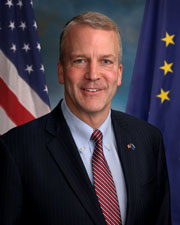
Dan SULLIVAN
Republican · Alaska
Ranked #20 of 100 senators
Total Score235
Actions7
Avg/Action33.6
Era Comparison
Biden Term
Jan 2021 - Jan 2025
Score210
Actions6
Avg35.0
Trump 2nd Term
Jan 2025 - Present
Score25▼ 88%
Actions1
Avg25.0
Tactics Breakdown
UC OBJECTION1 actions (25 pts)
Action History
Loading filters...
Wed, December 17, 2025
UC OBJECTION25
Four House bills (H.R. 131, H.R. 187, H.R. 410, and H.R. 1043) regarding public lands
Senators King and Padilla are reserving the right to object to a UC request, expressing concerns about House reciprocity and process issues, but ultimately indicating they will not object, creating minor procedural delay through extended remarks.
View floor text
Mr. President, we are here on the floor, a number of Senators from both sides of the aisle, trying to move some important legislation for all of us, our different States, and different constituencies. I have spoken a lot on this bill--my bill--the Alaska Native Vietnam Era Veterans Land Allotment Extension Act. So I am going to keep this quick. I will talk about this more, hopefully, once we get to a positive resolution. I do want to just thank my colleagues. A lot of people are working hard on this. I want to thank my legislative director Erik Elam, Senators King, Padilla, Bennet, Hoeven, and Senator-Chairman Lee--a lot of hard work, a lot of cooperation, on both sides of the aisle. I appreciate very much the cooperation. I think we will get to a good outcome here, and then we will make more commitments to help each other. That is what this body has long been about. All the Senators on the floor, I have the deepest respect for. As I will say later, I have said on the floor many times: This is an issue for some great constituents of mine--what I refer to as special patriotism, Alaska Native Vietnam vets. Alaska Native people serve at higher rates in the military than any other ethnic group in the country. This is going to be a good outcome, I hope, that addresses some of their challenges. I will talk in more detail about it. Mr. President, notwithstanding rule XXII, I ask unanimous consent that the Committee on Energy and Natural Resources be discharged and the Senate proceed to the immediate consideration of the following bills en bloc: H.R. 131, H.R. 187, H.R. 410, and H.R. 1043. The PRESIDING OFFICER. Is there objection to proceeding to the measures en bloc? The Senator from Maine. Mr. KING. Mr. President, reserving the right to object, I just want to raise a few concerns before we pass these four House bills. We have developed a new process in this Congress where, instead of passing a large public lands package, we are moving packages of smaller bills simultaneously. But for this new process to work, not only does the Senate need to pass House bills, but the House should be passing Senate bills. This Congress, the Senate has passed so far five House bills under the jurisdiction of our Energy and Natural Resources Committee by unanimous consent. All of them have been signed into law. During the same period, four bills from our committee--from our Energy and Natural Resources Committee--have passed the Senate by unanimous consent but are being held at the desk in the House and have neither been referred to committee nor taken up for a vote. And these are bipartisan bills. One is sponsored by Senator Cornyn, one by Senator Lankford, one by myself, and one by Senator Hickenlooper. So the picture is, we are passing the House bills, but they are not reciprocating and passing the bills that we have sent them from this Chamber. It is not sustainable for us to continue to do our side of the bargain and not have a response from the House when they refuse to even take up the bill. So the Senate has given the House the courtesy of taking up their bills, passing them in a previous group, as I mentioned, and now this group of House bills that we are going to be passing this afternoon. All I am asking is that the House extend to this body the same courtesy that we have extended to them. So this is about mutual respect and comity, and in the spirit of comity, I look forward to working with Chairman Lee and Chairman Westerman, and we can resolve these concerns in the new year. Mr. President, noting my reservations, I do not object. The PRESIDING OFFICER. Is there objection? The Senator from California. Mr. PADILLA. Mr. President, reserving the right to object, as the Senator from Alaska, the Senator from Utah, and others know, I have been down here many times as we tried to work through a better way of ensuring that we have a fair and bipartisan and bicameral approach to passing these public lands bills. The Senator from Maine just articulated one of the concerns about the Senate passing House bills or the House passing the Senate bills. Let me be a little bit more blunt and direct, because I don't think we are quite there yet, but I do think we are seeing the beginning of a more equitable process developing. I was encouraged to see that, just earlier today, a Senate Republican bill and a Senate Democratic bill were packaged together as a single bill and sent over to the House. I think this approach is critical to ensuring that neither the House of Representatives nor the White House can discriminate against our Democratic priorities. So I hope that we are now going to see action on the House side on that bill and other Senate Democratic bills, like that of my colleague from Maine, that we have sent over. Therefore, as a gesture of good faith, I will not object to the passage of these four bills today, but I want to be very clear--I want to be clear with my colleagues in this body and our colleagues in the House of Representatives--that I will not consent to any additional House Republican public lands bills passing the Senate until the House passes and the White House signs into law these Senate Democratic bills. Good faith must go both ways. I think it is critical that all interested Senators have an opportunity to sit down, when we return in January, with the leadership of both the Senate Energy and Natural Resources Committee and the House Natural Resources Committee to finally hammer out what that fair, bipartisan, and bicameral approach to passing public lands bills will be. Now, I also acknowledge--and this may be a little insight for folks watching from home--that this year we have welcomed a new chair, in the Senate, of the Energy and Natural Resources Committee, along with a new ranking member. On the House side, in the House Natural Resources Committee--which, Mr. President, you are very familiar with--the chairman there is not new, but as I understand it, given the rules of the Republican conference in the House, he is in his last session as chair, and there will soon be a new chair in the years ahead. There is a new ranking member of that committee in the House as well. So as there has been this transition of leadership in both Chambers in these two very important committees, I think it is even more timely to bring the leadership together with interested Senators to hammer out what the understanding will be to establish a fair, bipartisan, and bicameral approach to the consideration and approval of public lands bills. In that effort, I would appeal to our colleague from Alaska to help facilitate such a convening and the development of such an understanding and plan for going forward. So with my concerns being articulated and my request and suggested path forward being on the record now, Mr. President, I yield the floor. The PRESIDING OFFICER. Is there objection? The Senator from North Dakota. Mr. HOEVEN. Mr. President, reserving the right to object, I do have a hold on one of the bills in this package. It is not the bill that Senator Sullivan is talking about. It is one of the other bills. But I do have a hold on one of the bills. And it is because there are holds on the Democratic side on one of my priorities in the jurisdiction of the Energy and Natural Resources Committee. That is S. 675, which is the Theodore Roosevelt Presidential Library Museum Artifacts Act. This bill passed the Senate by unanimous consent last year. I will try that one more time. The bill I am talking about passed the Senate by unanimous consent last year. Now, there are holds on it. It is the Theodore Roosevelt Presidential Library, and it is scheduled to open on July 4, 2026, in concert with the 250th anniversary of the signing of the Declaration of Independence. The library will honor our Nation's 26th President and ensure that future generations of Americans can access the rich history and enduring impact of President Roosevelt. As President Roosevelt proudly claimed, he would not have ascended to the Presidency had it not been for his formative years in my State, North Dakota. President Roosevelt first traveled to the Dakota Territory in 1883 to hunt bison and returned in 1884, while mourning the passing of both his wife and his mother. President Roosevelt called the Dakota Territory home for 3 years, while enjoying the vast beauty that the Badlands have to offer. Fittingly, the Roosevelt Library will be located adjacent to the Theodore Roosevelt National Park. My legislation would authorize funding for the Theodore Roosevelt Presidential Library for continued construction and the preservation of President Roosevelt's history and his legacy. This funding would be contingent on matching funds from non-Federal sources. The measure also authorizes interagency agreements to allow for the exhibition of collections associated with Theodore Roosevelt that are currently in the custody of the Federal Government. As I said, there are, unfortunately, Democrat holds on this noncontroversial, bipartisan--bipartisan--legislation. Now, my understanding is that these holds are unrelated--unrelated--to the legislation itself. While I do have a hold on one of the bills in the package, I will acknowledge now that Senator Bennet has been working with me to help clear the holds on my Roosevelt Library bill, and I want to express my appreciation for his help, and I look forward to continuing to work with him. So, therefore, at his request and in the spirit of good faith, I will not object at this time. The PRESIDING OFFICER. Is there objection? There being no objection, the committee was discharged, and the Senate proceeded to consider the bills en bloc. Mr. SULLIVAN. Mr. President, I ask unanimous consent that the bills, en bloc, be considered read a third time. The PRESIDING OFFICER. Without objection, it is so ordered. The bills were ordered to a third reading and were read the third time en bloc. Mr. SULLIVAN. I know of no further debate on the bills en bloc. The PRESIDING OFFICER. If there is no further debate, the bills having been read the third time en bloc, the question is, Shall the bills pass en bloc? The bills were passed en bloc as follows: Congressional Record, Volume 171 Issue 212 (Tuesday, December 16, 2025) FINISH THE ARKANSAS VALLEY CONDUIT ACT The bill (H.R. 131) to make certain modifications to the repayment for the Arkansas Valley Conduit in the State of Colorado, was passed. Congressional Record, Volume 171 Issue 212 (Tuesday, December 16, 2025) MORNING BUSINESS