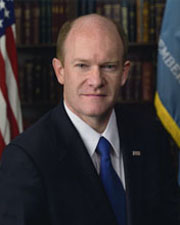
General Senate floor business being delayed through extended debate between cooperating senators
This shows clear coordination between Senators Coons and Booker in an extended debate session, with Booker explicitly maintaining control of the floor ('I yield for a question while retaining the floor') while Coons asks lengthy questions, creating a collaborative speaking marathon that has lasted '15 hours' according to the text.
View floor text
I had suspected that that might be the case, given that my colleague from New Jersey has dedicated his night to standing tall and fighting hard to make sure that the people of the United States know what is going on. I will share with you, just for a moment, that it hurt my heart to watch the national evening news last night and see a Chinese humanitarian emergency response team celebrated as they pulled survivors out of the earthquake rubble in Myanmar. It did not hurt my heart that there are Chinese nationals providing emergency relief, but it hurt my heart that exactly those people who are the very best in the world at responding to humanitarian crisis, exactly those people had just received termination letters and their work with USAID had just been suspended. Normally, in every humanitarian crisis I have known in my lifetime, the first in are the men and women of USAID and the U.S. Armed Forces. Whether a tsunami, a tornado, wildfires, or an earthquake, we had world-leading humanitarian response capabilities. And I think it is a tragedy--and it is reflected in both this article that I have asked my colleague about and in the response of the world-- that we have created an enormous opening for the PRC to come in and do what we previously did so well. Let me ask another question, if I might, of my colleague: Are you familiar with what has just happened to food banks all over our Nation in terms of an announcement about impending deliveries of badly needed surplus food? This, I suspect, will be the focus of your future comments on agriculture, but I mention it as something that has impacted my State and, I suspect, yours as well. Mr. BOOKER. First of all, I want to say this is when, when you ask me a question--to yield for a question--I want to say I yield for a question while retaining the floor, and I want to say to my colleague, I am familiar with some of this, but I--if as a part of a question to me and not anything resembling a colloquy, I will yield for a question while retaining the floor if you have another question. (Mr. MORENO assumed the Chair.) To my colleague, are you familiar with an article ``USDA halts millions of dollars worth of deliveries to food banks''? Mr. BOOKER. I pretty sure I am. I am. Mr. COONS. I will simply, then, ask my colleague a question. Mr. BOOKER. Therefore, if you are going to ask me a question, I yield for a question while retaining the floor. Mr. COONS. To my colleague, I ask the question: Are you familiar with the cuts that have been imposed on the U.S. Department of Agriculture, suspending hundreds of millions of meals to Americans in need and the justification for that being offered? Mr. BOOKER. I am familiar. I have mentioned it earlier in these last 15 hours, so thank you. Mr. COONS. Last question. Mr. BOOKER. I yield for a question while retaining the floor. Mr. COONS. To my colleague from New Jersey, I ask the question: Are you familiar with when, whether, and why NATO has invoked article 4 and how the service and the sacrifice that followed reinforces exactly the point I believe my colleague was beginning to speak to, which is the common cause and the common purpose shown by all of our NATO allies in America's greatest moment of need in recent decades after the attacks of 9/11? Mr. BOOKER. I am very familiar with that. It haunts me that when America was in crisis--I live 11 miles from Ground Zero. Mr. COONS. To my colleague, are you aware which of our European NATO allies lost per capita the highest number of their soldiers in combat serving alongside American servicemembers, a nation I visited, a nation whose servicemembers I visited, a nation that is today aggrieved by comments made recently? Are you familiar with our trusted ally Denmark? Mr. BOOKER. Yes, I am. That country that has shed more blood than any of our allies, side-by-side, fighting with America is Canada--is Canada. Mr. COONS. Denmark. Mr. BOOKER. Oh, it is Denmark. Mr. COONS. Denmark lost per capita, I believe--excuse me. Let me simply ask of my colleague one more question. Mr. BOOKER. Thank you very much. I yield for a question while retaining the floor. Mr. COONS. Is my colleague aware that broadly distributed across our NATO allies is service and sacrifice, including the loss of their troops in combat and that every single loss in combat was a loss of great service and sacrifice by our NATO allies? Mr. BOOKER. Yes, I am familiar. And I am grateful for your making those points. As we threaten Greenland, Denmark tried to bully them in a way that-- with rhetoric that fashions more after the behavior of Vladimir Putin's threatening before the Ukrainian invasion, as opposed to what allies do who are grateful for shared sacrifice, who are grateful for shared honor, who are grateful for shared prosperity. What is happening right now, to me, is shameful. How we are treating our allies is unacceptable. And the tariffs that will be imposed will indeed hurt Canada and other NATO allies, but they will hurt us in the long run more, not only with the immediacy of the driving up of prices for Americans, but what the President is doing as he turns his back on Republican traditions and Democratic traditions, it is going to hurt us more as a nation in the long run as other countries look to other places for leadership of the free world. Mr. COONS. Will my colleague yield for another question? Mr. BOOKER. I yield for a question while retaining the floor. Mr. COONS. Is my colleague familiar with the testimony of Gen. Jim Mattis, a decorated four-star Marine Corps general who served as Secretary of Defense in the previous Trump administration who testified about what the consequences would be if we were to defund development and diplomacy? Mr. BOOKER. I hope that the colleague of mine who, again, has been a mentor, a friend on all they things foreign policy, my belief is that he is referring to when General Mattis sat before the United States Senate and said very pointedly: If you cut the foreign aid, if you cut organizations like USAID, if you cut programs in the State Department, then buy me more bullets. Mr. COONS. Will my colleague yield for a final question? Mr. BOOKER. I yield for a question while retaining the floor. Mr. COONS. Does my colleague have an opinion about whether it strengthens or harms America in our national security to have an earned reputation as a nation of compassion, a nation that comes to the aid of those suffering through humanitarian disasters, a nation of compassion that provides healthcare and access for retirement in decency, a nation that cares for the least of these on the margins of the world and that has a just and inclusive society at home? Does my colleague have an opinion about whether it strengthens or weakens our Nation at home and abroad to earn a reputation for compassion and reliability or instead to deserve a reputation for unreliability and cruelty? Mr. BOOKER. So this is the powerful thing about my friend whom I went with on my first trip to the continent of Africa as a Senator, and I remember flying into Zimbabwe. The leader of that country had passed away, and you always correct me on my pronunciation so I am going to try my best pronunciation--Mnangagwa. Mr. COONS. Mnangagwa. Mr. BOOKER. Thank you, sir. The alligator was his reputation--had taken over as his leadership. And we, this bipartisan merry group of Senators were going there to sit there in a unified, bipartisan way and say to this new leader: You need to honor democratic principles. You need to honor free and fair elections, that we want to be your partner, we want to be your friend, but it is time for a new peaceful democratic Zimbabwe. And as we landed--I don't know if you remember--he was landing, too, in the airport. And he was coming from China. He was coming from China which has different values than we have. In fact, you and I both see now all over the continent of Africa a competition. We come with USAID. We come with PEPFAR. We come with a program called AGOA, helping with economic development. We come with scientists that stand in the breach against the worst infectious diseases. One of the most courageous things I saw Chris Coons do in my life was when the Ebola scare was happening 8 years ago and was starting to show up on our shores, you did something that people were afraid to do. You went to Africa to visit with the people from our country that are there fighting Ebola. You had to come and quarantine when you came back to make sure you didn't have it. It was amazing because you were going there to say to the world, I, Chris Coons, Senator from Delaware, is here, but America is here. America knows that an infectious disease anywhere is a threat to public health everywhere. America knows that when it comes to the globe, Martin Luther King was right in his spiritual proclamation in the ``Letter from the Birmingham Jail'' that we are all caught in an inescapable network of mutuality, tied in a common garment of destiny, that injustice anywhere is a threat to justice everywhere. I have been to where you have been, Kenya to Tanzania, traveling with you to Ouagadougou. You used to make me smile when I used to say the capital of Burkina Faso. Ouagadougou, my friend. There is a word I learned from a language, the Bantu language. It basically roughly translates into this: I am because we are. I am because we are. America has learned the power of soft power. General Mattis knew much cheaper investment, much more success, string of successes we have had in the last 25 years have been with our soft power, not with our 20- year wars in places like Iraq and Afghanistan. General Mattis knew that. He gave wisdom. He said: Do not cut the State Department. Do not cut USAID. They are making an invaluable contribution to fighting terrorism, to fighting instability, to spreading democracy, to fighting infectious diseases when we go and stand. But now, we are shrinking. We are retreating. We are pulling back. We are cutting aid. And when crises are happening like we are seeing in Myanmar right now, we don't even have the personnel to be there to help people. But you know who does? China. And they show up, and they leverage influence--you and I know this--to the continent of Africa. Here, take our money, take our money. Be in debt to us now. We have control. By the way, we want a military port here like they have right next to us in Djibouti. The Chinese are playing the long game, and Trump is playing into their hands and weakening our Nation, not just against infectious diseases, not just against the global fight against climate change, not just against the economic opportunities that we are missing out in the Continent of Africa. Guess what, if you don't know this: By 2050, one out of every four people on the planet Earth will live on the continent of Africa. One of three working-age people on the planet Earth will be on the continent of Africa. China is playing the long game, not only critical rare earth minerals but the economic power of the most populous continent on the planet. And what are we doing with Trump? We are doing the Michael Jackson. We are moonwalking away from that continent, saying: China, go ahead. I love you Chris Coons. I am the ranking member of this subcommittee inspired by you, Chris Coons, and the work that you and me and Lindsay Graham and John McCain did over the last 10 years is being swept away as our allies are saying frightening things; that they have to look elsewhere for leadership and not to the people who saved the free world. It is a shame what we are doing to my grandparents' generation, with my grandmother with her war bonds and her victory garden and my grandfather building bombers at the Willow Run bomber plant in Michigan. All the country came together and sacrificed for the war effort. We saved Europe. We bled and died on that European Continent. There are--and you have seen them--these fields of crosses and you see some Stars of David and you see some Muslim graves. You see it all. Our American boys died. And yet we still invested in that continent. We still invested with the Marshall Plan. We still invested with the Berlin Airlift. We still stood up to communism. And a great Republican President--a great Republican President--who stood up in front of a Russian autocratic leader and said: Gorbachev, tear down this wall. And what is Trump going to be remembered for? I really love Vladimir Putin. Zelenskyy is a dictator. You are my friend. You and I both visit VA halls, and occasionally, we meet a World War II veteran. In my State, there are some incredible men that still wear their hat. If they can, they stand with pride. They are called the ``greatest generation.'' And what are we doing to their legacy? What are we doing to their legacy, Chris Coons? I am going to keep talking unless somebody wants to say: Will the Senator yield for a question? Mr. MARKEY. Will the Senator yield for a question? Mr. BOOKER. I yield for a question while retaining the floor. Mr. MARKEY. First of all, thank you so much for what you are doing, Senator Booker. You are drawing our Nation's attention to what Donald Trump and Elon Musk and DOGE are seeking to do to our country, especially the most vulnerable in our society. You, Senator Booker, you have been a champion for the poor, for the sick, for the disabled, for those most in need throughout your entire life. That is who you are. You are absolutely a champion for those who need help the most. So as we look at what Donald Trump is proposing, to destroy the Department of Education, just to level it, knowing that title I money goes to the poorest children in Newark, in Boston, so that they can have as close to an equal footing as is possible so they, too, can compete to ensure they enjoy the American dream. To dock Medicaid, knowing that there are 338,000 people just in Massachusetts alone who are on disabilities, who need Medicaid in order to deal with those afflictions, which their families need a little bit of help to deal with, to begin a process of saying that Social Security is a Ponzi scheme and knowing that, ultimately, they need the billions of dollars for their tax breaks for millionaires and billionaires, and they have to get it out of education. They have to get it out of Medicaid. They have to get it out of veterans' benefits. They have to get it out of Social Security. We know what the plot is. The plot is to get $2 trillion out of programs that affect ordinary people in order to have tax breaks for the wealthiest people in our Nation. And most of it will come out of healthcare. It will come out of Medicaid, ultimately, out of Medicare, out of the Affordable Care Act, out of veterans' benefits--healthcare, healthcare, healthcare, healthcare for every family, for the wealthiest in our society who don't need a tax break. The one thing they don't need right now is a tax break, especially when Elon Musk and Jeff Bezos and Mark Zuckerberg now control more wealth than the bottom 50 percent of our Nation combined. Do they really need a tax break? I mean, I know the President put them right behind him at his inauguration, but oh my God, the Cabinet sits behind billionaires? The Founding Fathers are spinning in their graves thinking about how they have perverted what is supposed to be the way in which our government, our country works. So I thank you for your incredible leadership. You are putting the spotlight on what is going wrong in this country right now, this oligarchy seeking to take over our Nation. So I thank the Senator for what he is doing, and he is just so consistent with his whole life, what he stands for. What he stands for on this on the floor of the Senate today is a conscience--a conscience for the Nation. Can the Senator tell the Senate today--the Nation--what does it mean if we continue down this path of Donald Trump and Elon Musk and DOGE for those families who need help the most in our society? Mr. BOOKER. I so appreciate the Senator, and I want to tell folks that when I wrote my book, I thought I knew this man here. I did a lot about environmental justice in my book. I did a lot about these toxic chemicals out there that are threatening our people. I came to the office of the Senate one day so humbled because I told him: I knew you as my colleague. We both got here around the same time. But I had no idea of the kinds of things you did in the U.S. House of Representatives, how many bills that made a difference in people's lives in Boston, in Newark, in Camden, in Passaic. You are one of the people that, after a few years here, I discovered in 2015, writing my book, how amazing your career is. And now having served in the Senate about the same amount of time, I am so grateful for you. You have been so consistent in why you came here, not forgetting the people you have been fighting for for your whole career. So your question is right aligned with that point. It was said earlier about things that humanity's biggest fight, humanity's biggest consistent theme is us versus them or just us. I don't like when you pit one group in this country against another group. It is not us versus the billionaires or us versus the Republicans; it is understanding what is best for ``we the people.'' How can we create a more perfect Union? I will tell you this right now, we are a Union in trouble. Compared to our global peers, we have higher disease rates, higher diabetes rates, higher cancer rates, higher maternal mortality rates, higher premature birth rates, and higher infant mortality rates. There are so many things going on in this country that should not go on. But yet we are a nation of utter abundance. We are a nation of incredible wealth and resources, and we have proven in our past to be a nation of incredible vision. That is why I don't understand why we are playing so small, why we have a President that is playing so small. It is not coming here like Presidents of the past and saying ``We together,'' from Reagan, to Clinton, to Obama. There is a big challenge, America, and we together are going to get into the room and do sausage making, Republicans and Democrats, and we are going to find a way to write great legislation. Whatever you want to say about Joe Biden, he was a big President because he didn't try to do things by Executive fiat or this quote of Donald Trump's I put here, ``the primacy of the Executive,'' ignoring our Constitution. Do you know how many bipartisan bills were hammered out here? I see another dear friend of mine, Mark Warner. Do you know how many bipartisan bills Mark Warner was at the table for, my senior Senator who was chairman of Intelligence? We did a bipartisan infrastructure act when Trump, in his first term, had infrastructure week every other week. We did a Chips and Science bill. He is trying to claw back the money. But we, together--I still remember that classified SCIF where the whole Senate was there and our national security team, and Gina Raimondo put forward the crisis in our country, the vulnerabilities, and we came out of that room, we got into our rooms, and we hammered out a great Chips and Science bill. Decades went by in this body with doing nothing on gun violence-- decades. Courageous people on the Republican side, friends of mine that surprised me that stood up--like Senator Cornyn--and said: We are going to do something. I have my lines, you have your lines, but let's find space in the middle. We did programs. If you come to New Jersey, the community violence intervention money is lowering murder rates in places like Newark by over 50 percent and helping to get it done, along with our great law enforcement officers. The incredible thing about that now is Trump is trying to claw back that money, violating the separation of powers because we decide how we are spending money in America, not the Executive. Read the Constitution. So you and I both know that a big President would come here and say: Let's do some legislation. But John McCain--and I read it in the middle of the night--but John McCain--it is really important--John McCain--I won't read it, but I will tell it--voted against the healthcare last time, the taking away of healthcare from millions of Americans, and said that it is because of the dysfunction of this body that we don't come together and do something bigger and bolder to provide better healthcare, to bring the ideas from both sides and expand the opportunities for Americans and replace the imperfections of the Affordable Care Act with smarter and better things. Not Donald Trump. He is repeating--why?--the mistakes, but not with the ACA, which affects tens of millions of Americans, with Medicaid, which affects 70 to 100 million Americans. Why? You ask why. Well, we know why. There are two things that this will achieve--two things. One, as you said, it is because he wants to not just renew the Trump tax cuts but expand them to have disproportionate benefits to the wealthiest. I wish the wealthiest in the country, names that we know, people like Elon Musk, would say: I don't want a tax cut. I wish he would say the truth: I don't need a tax cut. But that is one of the reasons. He wants to renew a program that gave disproportionate money. But that is not the only reason. There is a cruelty in what he is doing. It is so offensive. He seems to have no respect for people with disabilities. He made fun of a journalist with a disability once. He seems to have no respect for people who are working hard and struggling but still can't make ends meet, no respect for people that are afraid of his language, of his threats. They think that what he is doing to Social Security might mean they don't have it. What he is saying about Medicare and Medicaid are lies. He has more registered lies than any President of my lifetime. They don't think they can trust this President not to hurt them because he already is. I was told by my parents that what defines you as a person is not what happens to you but how you choose to respond. What happens to us as a nation is not what defines us. They can bomb us at Pearl Harbor and attack us on 9/11. The American character was defined by how we responded to those crises. Yes, there have been major political crises before, but we responded by bending the arc of our Nation more towards justice, taking care of more and more people, saying that we belong to each other in America. It is ``we the people.'' It is ``we the people.'' I see the standing of my friend Mark Warner. I don't know if he has a question, but I know what I am told to say if he asks me to yield for a question. Mr. WARNER. Will the Senator yield for a question? Mr. BOOKER. I yield for a question while retaining the floor. Mr. WARNER. Mr. President, if I may join my friend and colleague from Massachusetts, one, to celebrate the Senator from New Jersey's endurance, his willingness to continue to make his case in as clear terms as possible. Not having been here last night at 6:30, I do wonder, when he started this speech-a-thon at 6:30, whether the bob and the weave and the move were quite as strong or was he firmly attached to the podium. The fact that you are going on more than 12 hours now and you look like you have hours ahead and hours before you sleep and knowing that there are other Members who have a question, including the majority leader, I just want to be brief with mine. You have talked a lot with great passion about the damage done domestically. As chairman of the Intelligence Committee and now vice chairman, I have been aghast at the sloppiness of this administration time after time after time in terms of their treatment of classified information. In the first 2 weeks of the administration, strangely, a couple hundred CIA agents' identities were revealed on a nonclassified chain. These probationary employees, these new employees--the American Government had spent a couple hundred thousand dollars on each of them. You have to get a security clearance. You have to get them trained. Unfortunately, these folks can't deploy abroad. They can't deploy undercover because their names were carelessly put on an unsecured channel. You say, well, that was just a one-off. Well, what about a week or so later? The DOGE boys print a whole list of Federal properties that should be for sale. They quickly take it down a few hours later, realizing they once again have screwed up. But in putting up that list, they put on classified dark sites that the American Government, again, spends millions of dollars to protect. More recently as well, the DOGE boys, either ignorantly or maliciously, either one--just plain stupid--put out the list of a classified Agency, its budget, total head count--again, all classified information. Senator, one thing I can tell you, and I know you know this as well, if this had happened to a line intelligence officer or a line military officer, there would be no question--your butt would be fired. As a matter of fact, we got information yesterday that there had been a DHS employee who had inadvertently--inadvertently--put a journalist on a chatline. Guess what happened. The guy was fired. So when it came to this incident now called Signalgate or the Signalgate fiasco, where you have the leading members of this administration debating where and how we should bomb the Houthis, including specific information of who will be hit and when, I was-- Senator Booker, I was down in Hampton Roads this week, and these were the communities that surround the Norfolk Naval Station. The Norfolk Naval Station is where the Truman, the aircraft carrier, has been deployed from. It is the aircraft carrier that the flights that attacked the Houthis flew off of. I can tell you one thing, Senator Booker: These people were pissed off that there had been this level of carelessness about their loved ones, that if it had gotten in the wrong hands, it would have cost American lives. So, Senator Booker, as you put down the litanies of all of the challenges that have been raised by this administration, I will ask you a simple question: Do you agree that this pattern--not a one-off-- Mr. BOOKER. Yes. Mr. WARNER.--this pattern of sloppiness endangers our national security? Mr. BOOKER. Yes. Absolutely, yes. I love that you gave that litany, Senator. I benefited from your leadership on the Intel Committee. You are one of the people that--when things go down on planet Earth, you are one of the small handful of people with the highest security clearance here. You know before rank-and-file Senators do. We have had so many conversations about threat matrices and what our enemies are doing. You have sent me to the SCIF and said ``I can't talk to you about this; go down to the SCIF and ask for the information'' and helped me to fill out my understanding of national security. But I am stunned by this President. All that I have read in the SCIF about what Russia is doing to this country--I am stunned and angry at this President and what he is doing to us by cozying up to Putin and turning his back on our allies. But the sloppiness, the unqualified leaders that he has put in place--it has caused us to be more at risk. And Signalgate--you said it. If that had happened under any other President, Republican or Democrat, whoever controlled the Senate would have hearings. They would want to know: Was this pattern and practice? Did these Signal conversations happen before and we only know about this one because somehow you pulled in a journalist? Well, that is a violation of the law because their disappearing messages were destroying government documents that the executive branch has a legal obligation to keep. And classified materials--putting it out there saying there was nothing classified about that, lying, then they put up the actual--if there is nothing classified, then release the whole thing. To the wisdom of people like you--again, more wisdom and experience at intel than me--it is clear that was sensitive, probably classified. But we should be having hearings and accountability. I keep going back to how this document is being undermined and attacked by this President. And one of the powers and responsibilities that we swore to uphold--every one of us swore to uphold that we are to be a check on the administration. Before I yield to the next question from Senator Schumer, I want to talk about Senator Schumer. I want to say something and get it off my chest. Senator Murphy, we passed the 15-hour mark. I want to thank Senator Murphy in particular because he has been with me the whole night. He hasn't left my side. In some ways, that repaid the 15 hours because we called Chuck Schumer 9 years ago--9 years ago. I remember exactly where we were standing when the three of us were on the phone. We asked Chuck to help us, for you to take the floor right down there and do a filibuster. We didn't know how long it was going to last. I committed to you I would be your aide-de-camp. And 15 hours you stood, Chris Murphy, saying this Nation shouldn't do business as usual for the Postmaster. The leader of the Senate, 9 years ago, said, ``I support you guys. Go ahead.'' So one of the first people I called was Senator Schumer and talked to about this--actually, it was Murphy. He did full circle for me and has been with me the whole 15 hours. The debt is paid, but I have fuel in the tank, man. The only reason you stopped wasn't because you couldn't go on anymore. We got a concession from Mitch McConnell. We got a concession to get two votes on commonsense gun safety that Republicans had put forward, like universal background checks in the past. But we lost that vote. On both occasions, 9 years apart, once when Murphy was the principal and now here, we had a leader who said: Yes, how can I help? I want to thank Senator Schumer before, I suspect, he might ask and yield for a question, for being a friend, a partner, and one of the first people I turned to with this idea and encouraged me to go for it. ``Go for it, Cory.'' Thank you, Chuck Schumer. Mr. SCHUMER. Would the Senator yield for a question? Mr. BOOKER. I yield for a question while retaining the floor. Mr. SCHUMER. I have two questions, frankly, one on Medicaid cuts, which we talked about last night, and one on tariffs. First, let me say before I get to this question that your strength, your fortitude, your clarity has just been nothing short of amazing. And all of America is paying attention to what you are saying. All of America needs to know there are so many problems because of the disastrous actions of this administration in terms of how they are helping only the billionaires and hurting average families. You have brought that forth with such clarity. People from one end of America to the other admire you. Our whole caucus is behind you. And we admire your stamina, your strength, your passion, your intelligence. The list of adjectives could go on. My first question relates to the Medicaid cuts. As we talked about last night, I visited three Republican districts--one in Staten Island, one right on the border of two Republican districts in Long Island-- yesterday to talk about Medicaid cuts. I went to nursing homes. It was clear that the Medicaid cuts that are proposed in this proposal--$880 billion in the House--would be devastating. On Staten Island, the nursing home we visited--they love it, Silver Lake nursing home--would close. Three hundred people would lose their jobs; hundreds would be thrown out. And most of them said their children can't take care of them. It is too--their needs are more advanced. Even some who said their children might be able to take care of them didn't have room in the house, et cetera. So it is affecting Staten Island, middle class, voted for Trump. But we made a plea to their congresswoman to not vote for any bill that had these Medicaid cuts in the tax breaks for billionaires. A lot of the people there were--it was bipartisan, both parties there. We estimated that about 18,000 people total would lose their jobs with these Medicaid cuts, creating a recession on Staten Island. We estimated the harm that it would cause. So this was devastating. Same thing on Long Island. Again, Republican areas with Republican Congress people who hold the balance. If those three Congress people alone would say: I am not voting for a bill that cuts Medicaid to give tax breaks for the billionaires, the bill would fail. I know that you in New Jersey and my colleagues in Massachusetts, Connecticut, and elsewhere are doing the same thing, Congressmen and Senators. I talked to Leader Jeffries. He is doing the same with his folks. So my question to you is very simple. If these people in New Jersey, in New York, across America are kicked out of nursing homes and assisted living facilities and healthcare facilities, what would they do? How could they--and how does the Senator, with his passion and everything else, feel when the only reason they are doing this is to give tax breaks to the wealthiest of Americans? Would you please answer my question, sir? Mr. BOOKER. Yes, I will, Leader Schumer. Earlier, or late last night, rather, I read dozens and dozens and dozens of letters from terrified people. The stories were heartbreaking as people rendered their pride and gave us insights into the more painful aspects of their lives. I got emotional over one about a person talking about being diagnosed with Parkinson's and knowing the disease would be more and more debilitating, like I saw with my father, and demand more and more help. And she was paranoid that the burden on her family, they couldn't afford it. I had these amazing--this one amazing letter about a person who said they were in a sandwich generation--two 90-something-year-old parents they were taking care of and two adult men--children--with disabilities. For all these people, like you saw in the nursing homes, Medicaid wasn't a plus or some kind of abundance heaped upon their lives. It helps them keep the fragile financial world they were living in stable. And it is not just the $880 billion cuts, Senator Schumer. Half of that or a quarter of that would cut services that would pull apart their whole lives--their ability to care for their loved ones, their ability to still work. One person just said the transportation we get through Medicaid for my disabled child is the link that holds it all together. And callously and cruelly, they are talking about this, not in any kind of insightful way, not in any kind of ``here is how we can make it more efficient and help keep it.'' There is none of that thought or logic, bringing in experts because we read page after page after page from rural hospital leaders, of urban hospital leaders and more and more. Your question is clearly that it is this crazy scheme right now to expand the Trump tax cuts that overwhelmingly disproportionately go to the wealthiest of us in America who need not our help; that would still yet expand the deficit by trillions of dollars, which means your children--and I know how proud a grandfather you are--your grandchildren would have to pay for that debt. They are stealing from your grandchildren so that the wealthiest amongst us could get bigger tax cuts and, at the same time, taking away medical coverage from the most vulnerable. What is that? It is not who we are. It is not who we are, America. And as much as people--thousands depended on us to save the ACA-- Medicaid affects millions and millions of more people. Wake up. They are coming after a vital program for American expectant mothers, for American children, for American disabled, for seniors like the ones you visited. I have one more thing to get off my chest, sir. This is a little lighter. You heaped so many kind things on me, I don't know if you realize that never before in the history of America has a man from Brooklyn said so many complimentary things about a man from Newark. Mr. SCHUMER. I would remind my colleague that we are both New York Giants fans. Mr. BOOKER. Who play where? In New Jersey. This is not a colloquy. I hold the floor. I do not yield. Brooklyn stole the Nets--it is an injustice--from Newark. They stole the Nets. I do not yield the floor for a rebuttal. And the Giants and the Jets play in New Jersey. There is only one football team in New York, and that is the Bills. I do not yield, but I do love and respect you. When I have the floor, I don't have to yield. The one time in my life I get the last word with my much more senior, much wiser friend and Senator. Mr. SCHUMER. My colleague, I do have another question on an unrelated subject. Mr. BOOKER. OK, unrelated. As long as you give me that commitment, I yield for a question while retaining the floor. Mr. SCHUMER. First, let me say before I ask my question, Go Bills. Second, given the 15 hours which you have shown such amazing strength of an all-American athlete who could probably, given what you have shown tonight, be a star on our Giants--so I will not even try to rebut where the Giants are. Mr. BOOKER. Thank you. Mr. SCHUMER. I will ask this question. Going back--before I get to tariffs--one of the leading hospitals in New York told me if there were only a 20-percent cut of Medicaid, less steep than they show, that they would close. They are the only cancer care place in the Bronx, 1.3 million people, and they give great care. They are the only ones. They would close. So the devastation of these cuts, the American people should realize, is just enormous from one end of the country to the other--middle-class communities and upper middle-class communities like Long Island, middle-class like Staten Island, and poor communities like the Bronx. On tariffs, let me ask a question. So here we are, right on the edge of April 2. Today is April Fool's Day, but the tariffs the President is proposing, unfortunately, are not part of an April Fool's trick. They are real, and they are devastating. My question to my colleague is: With these tariffs, which is estimated would cost the American families $6,000 more on average, would raise costs on everything across the board, and would throw devastation into our economy--look at the stock market. It goes down when Trump is serious about tariffs, then goes up when he says maybe he is not so serious. And with the chaos that it has caused so businesses which love certainty--small businesses, medium- sized businesses, large businesses need certainty. So my questions are these. Does the great Senator and great Giants' fan from Newark agree that prices could go way up, all the way up to as much as $6,000? And does he agree that the chaos from Trump's tariffs is discombobulating the economy in very serious ways? And, again, does he agree that the reason they seem to be doing this, they count the revenues. This guy Navarro seems to have no sense of reality, yet he seems to be in charge. And they count the revenues to help them get more tax cuts for the wealthy. Almost everything they do, including tariffs, it seems to me, is aimed at getting those tax cuts for the wealthy. God bless the wealthy, as I heard you say last night when we spoke. We are not against people who make a lot of money. God bless them, but they don't need a tax break. Mr. BOOKER. No, they don't. Mr. SCHUMER. They should realize the beauty of America helped them become or stay billionaires. The money we invested in education and roads and schools and helping kids get food makes a better workforce. So my question to my colleague on these tariffs, A, does he agree that it could raise the price on an average family thousands of dollars--it is estimated $6,000. Does he agree that the chaos caused by Trump's on-again, off-again, this-country, that-country, this-much, that-much, this-product, that-product is hurting the economy and hurting business people doing their jobs? And does he agree that it seems the motivation is tax breaks for the wealthiest people? Will you please answer my question? I yield back to the Senator from New Jersey. Mr. BOOKER. I will. So you and I both know that in 72 days now--it is the next day--that of the 72 days that Trump has been in office, he has caused havoc on the American economy, especially given the economy he inherited. Inflation is up. Prices are up. Consumer confidence is down. The stock market and people's 401(k)s--their retirement plans--are down. He continues to do things to rattle confidence, to raise prices, and to hurt not the billionaires--the people who can afford these things--but to hurt average Americans, who find housing prices too high and difficult to make ends meet. Every time--and I have looked at the tariffs throughout history. In fact, one of my friends sent me this really funny clip I hope somebody will put up for me from, I think it was ``Ferris Bueller's Day Off'' where he was talking about tariffs and was like ``Bueller! Bueller!''-- or maybe it was another movie. I am mixing it up. It shows my-- Mr. SCHUMER. You are entitled. Mr. BOOKER. What is that? Mr. SCHUMER. You are entitled. Mr. BOOKER. Thank you. But the tariffs haven't worked out for Republican Presidents who tried them during the Depression. The evidence is here. Learn from our history. Mr. SCHUMER. Sorry. Does my colleague remember the names of Smoot and Hawley? Mr. BOOKER. Smoot and Hawley. Yes, sir, I definitely remember those names from high school history. God bless you, Mr. Al Gore and Mr. Perot. So, yes, what he is going to do tomorrow is going to rattle the markets. What he is going to do tomorrow is raise prices for Americans. What he is going to do tomorrow is lie to folks and say this is something that China will pay or whoever will pay when actually it is the American consumers who will pay with higher prices and more economic insecurity. This man--I will tell you this quote that Frederick Douglass once said. This I do remember. He said: The limits of tyranny are prescribed by the endurance of those whom they oppress. How much more will we take of this? How much more will we as America say ``Cut our Medicaid to give tax cuts to the billionaires. Take the Affordable Care Act, and take away tax credits. Take away enrollment support. Hey, come after Social Security. Cut thousands of people. Make customer service get worse,'' as said the Wall Street Journal? How much more of these indignities will we take as he turns our back on our allies? How much more will we take--how much more?--of a person who is doing tyrannical things as he takes our Constitution and continues to trash it as he is running into judge after judge after judge who is trying to stop him? But we have already seen that he wants to ignore judges or if he gets rulings he doesn't like, he trashes the judges, and even the Chief Justice, appointed by a Republican, says: No, no. This is not right. This is not who we are. This is not how we do things in America. How much more can we endure before we in the collective chorus of conviction in our country say: Enough is enough. Enough is enough. You are not going to get away with this. Mr. SCHUMER. I thank the Senator for his fortitude, his strength, and the crystalline brilliance by which he has shown the American people the huge dangers that face them with this Trump-DOGE-Musk administration. I yield the floor back to my colleague from New Jersey. Mr. BOOKER. Thank you. Thank you. The PRESIDING OFFICER. The Senator from Massachusetts, but I think you have to ask him to yield for a question. Ms. WARREN. Mr. President, will the Senator yield for a question? Mr. BOOKER. I yield for a question while retaining the floor. Ms. WARREN. I am very grateful to the Senator from New Jersey for coming to the floor for such an extended period of time to give voice to all of those around this country whose voices evidently are not heard by the Republicans in the U.S. Congress. I wanted to ask a question for the 73 million people who are beneficiaries of the Social Security System and for their families--for the people whose grandmas are getting Social Security, for the people whose cousins or whose dads died who were getting Social Security benefits, about what is happening right now between Donald Trump and Elon Musk, our current co-Presidents, and what they are trying to do to the Social Security System. So I start this question with just a basic observation. Social Security is not charity. It is not something we give away to those who are less fortunate and we do this out of the goodness of our hearts. Social Security is a contract that people who work in America pay into; it is the system for all of their working lives. When the time comes that they retire or something happens to them and they are not able to do that work, they can count on the Social Security System and the payments they are legally entitled to. I want to underscore here ``legally.'' Now, if America wanted to change that contract, the place they have to go is right here, to Congress. Mr. BOOKER. Yes. Ms. WARREN. They have to come to the U.S. Senate or they have to go to the U.S. House of Representatives, and they have to say: We actually want to change benefits for Social Security recipients. By the way, that has happened dozens and dozens of times in our history, up through the late 1980s, when we made adjustments in the Social Security benefits--for example, for the fact that people lived longer, for the fact that people worked longer, and so we made minor adjustments in the system. We also made adjustments to make sure that there were cost-of-living changes in how much Social Security would pay out. So anyone who wants to change the benefits that people are legally entitled to has to come here to Congress and make that happen. But it appears that Elon Musk and Donald Trump have tried to figure out an end run, and the end run is to say: OK. We can't directly change benefits, but what we can do is we can effectively cut off benefits. Now, how can they do that? Well, one way is to fire all the people who help people get their Social Security benefits. Think of it this way: There is someone who wants to collect Social Security. Let's just say, at age 66, they decide, ``I am ready. It is time for me to retire. I can't do this anymore. I want to collect my Social Security benefits,'' and they try to fill out the form. It turns out it gets rejected. There is a number off somewhere in the system. Somebody has gotten confusion on what the name is or where somebody worked or an employer from decades back failed to fill out the right form, so now there is a problem in the system. So what does a person do? Well, first, they might try calling, but if you fired the people who answer the phones, that is not going to work. OK. So what is the next thing you do? You go to your local Social Security office. Oh, but if they close the Social Security office near you, that is not going to work. So what do you do? You go to the Social Security office that you can find that is 2 hours away, 3 hours away, 4 hours away. You finally get through to that Social Security office, and when you get there, if they have fired most of the people, you may encounter what? Two people working the desk to help straighten out problems and a line that is 50 people long. By the way, these come from real stories. People are telling us what is happening out there. So by the time the day is over, our example here hasn't even made it to the front of the line. So he doesn't get the question answered. He doesn't get the problem resolved. He has to go back home again and has to find somebody who can maybe take him to the Social Security office that is hours away and start this process over and over and over. If this person--let's just say for example it takes 3 months to get this problem ultimately resolved by the Social Security Administration. They don't get the money. That money is lost. It just simply is gone. They do not get the money they are legally entitled to, and they have no right to go back and collect it, even pointing out that it was Social Security's error. So the failure to correct these errors or to give people an opportunity to correct these errors is effectively the same as having cut their benefits. When you do that for 1 percent of the people, you drive up your error rate. When you do that for 5 percent of the people or when you do that for 10 percent of the folks who are getting Social Security--and, man, those cuts really start to add up--they really start to add up for the people whose benefits are cut. They really start to add up for Donald Trump and for Elon Musk. Let's look at another possibility here, and that is just simply delay. Checks don't go out on time. When checks don't go out on time, then the promise that people relied on that that check would come on the 3rd of the month is what they count on for rent. That is what they count on to put groceries on the table. That is what they count on to support themselves. It is gone. So maybe he will get the check next month. Another billionaire Republican, Howard Lutnick, said: Don't worry about it. His mother-in-law would simply count on the fact that they would straighten the problem out, and maybe next month, she would get her payment. I suppose if your son- in-law is a billionaire, you can count on the fact that somebody will make sure your rent gets covered and groceries are on the table, but for the 70 million Americans who rely on that check coming in every month, it is not so clear what you are going to do. So what do you do? Do you borrow money to make rent? Do you call on relatives if you have them? Whom do you go to to be able to make it to the end of this month and, if the problem persists, to the next month and the next month? Where do you go? That is, in my view, as much a benefit cut as Congress's having voted to say: We are just going to give a 10-percent across-the-board cut to everyone who receives Social Security benefits. There are a lot of ways to cut benefits, and breaking your promise to 73 million Americans is a benefit cut. It is not a legal benefit cut, but it is an effective benefit cut. I admire the Senator from New Jersey for being here today to speak out for those Americans who face these kinds of cuts and have no recourse. I admire him for standing up and saying to the Republicans who won't go do townhalls and who won't go out and meet with these people and listen to them: Listen to their concerns. Listen to their fears. Listen to their stories about what happens as thousands and thousands more Social Security employees are fired. Correcting problems and straightening out your benefits gets harder and more out of reach for more and more Americans. That is what we face right now. So the question that I want to pose to the Senator from New Jersey is this: At a time when Donald Trump and Elon Musk are looking for an indirect way to cut Social Security benefits--and let's just pause here, if I can, to say, Why? Mr. BOOKER. Yes. Ms. WARREN. Why go out of your way to cut Social Security benefits? Come on now. There are 73 million Americans who rely on this. This has been the backbone of America's promise to its own people that you did the work, you put in the money, and now you are entitled to the benefit on the other side. Why are they doing this? Because they want to reduce the amount of money that is available for Social Security and instead take that money over so that they can advance tax cuts for billionaires and billionaire corporations. They are just trying to grease the skids here for the billionaires to get even richer and ask the 73 million Americans who rely on Social Security to pay for it out of their own hides. So the question I have for the Senator from New Jersey is, When Elon Musk and Donald Trump are determined to try to use a backdoor way to cut Social Security benefits, A, are they acting legally, and B, how do we put a stop to this? (Mr. SHEEHY assumed the Chair.) Mr. BOOKER. Amen. Amen. You know, Reverend Warnock was here earlier and was preaching and quoting Scripture, but you are preaching the gospel of truth, my friend, from a civic gospel that speaks to the cares and the concerns of American hope and of the American dream and of the American Constitution, because you and I both know the answer to the question. I have to say, for the folks who are watching, she is the great Senator from Massachusetts, but she used to be a professor in New Jersey. Ms. WARREN. That is true. Mr. BOOKER. She was a Rutgers professor. I was listening to her way before I got to the Senate when she was fighting for the CFPB, when she was fighting so people would not be taken advantage of. She established the first-ever Agency whose sole purpose was to stand up to the Big Bs--to big banks, to big corporate powers--and defend people. It is an institution that got billions and billions of dollars back into the pockets of the American consumers. What did Donald Trump and DOGE do to an institution that we set up in Congress in a bipartisan way? They did something that is against the Constitution. They went after it to hack it to pieces so that it is no more. But to add insult to injury, down here, we just had a vote on overdraft fees that was stunning to me because there is just no defense of it. It was a clear thing. Some of the big banks said: Do you know what? We don't need those usury fees. It is actually wrong. Those are the big banks that stood up and did the right thing. But a handful of others were still taking advantage of people, and this Senate got to vote on which side are we on. And we failed. So your question is right. You detail what is right about how people are getting hurt already, how the benefits of Social Security are already being affected, how rural Social Security offices are being closed already. And the question is why, under the guise of efficiency, but you are hurting our elders who deserve dignity in their retirement. It is stunning to me, Senator Warren--stunning to me--that we are actually even having this discussion and having this debate when there has been not one congressional hearing about what Elon Musk is doing. The letters I read earlier about Social Security were painful because people wanted to know what was being done with their most confidential and private information. I want to continue because we were working through national security. And given the time, I want to rush to just read some stories of voices. I wanted to come to the floor and read people's voices, elevate voices. So here is a voice, a statement from Julia Hurley from Bergen County, NJ. Thank you, Julia. I see you. My family's roots are deep in New Jersey, all the way back to my great-grandparents, with my mom's side from Bogota, Fair Lawn, and Upper Saddle River and my dad's side from Spring Lake and Wall Township. I have north and south roots. My grandfather started a manufacturing company that my cousin still runs, and my other grandfather ran a trucking company based in New Jersey. I was born and raised in Park Ridge and learned from a very young age about the importance of serving and community. Both of my grandfathers served in World War II. What a family. My family was always involved in charity and our churches. And ever since I can remember, I wanted to help people, doing my first fundraiser for homeless people in Bergen County, when I was maybe 8 or 9. The passion for service took an international bend after I went abroad for the first time during an exchange trip to Germany with Park Ridge Junior-Senior High School in 2001 and fell in love with travel. Shortly after that, September 11 happened. Seven people from my little town were killed in the towers, and we could see the smoke from Ground Zero from a hill the next town over. For those of you who don't know, Park Ridge is very close to where I grew up, and my childhood best friend died in the Towers. This was when I learned how my little suburban bubble could be impacted by things worlds away. I became obsessed with trying to help and wanting to drive a career that would be in service to my country and people elsewhere so that those people would be more inclined to work with us than against us. I went on to study diplomacy and international relations at Seton Hall University, graduating magna cum laude and determined to work for the State Department at some point. My 15-year winding career path after that took me into the advocacy space and onto humanitarian and peace-building work in Gaza with the U.N., as well as in Tunisia and Egypt. In 2022, after years as a policy advisor with the International Committee of the Red Cross, I was recruited to join USAID. And I couldn't have been more excited. This was a dream job, an opportunity to serve my country and impact policy in a real way, sharing what I had learned from working abroad and at home to shape U.S. foreign policy and efforts to advance development and humanitarian assistance on the ground. I was eventually promoted to a senior policy advisor role in USAID's Office of Policy, where I was developing policy that was shaping the way USAID worked, trying to break down silos across the Agency, to be more effective and efficient in our response to some of the toughest crises in the world. I got the opportunity to not only prepare talking points for high-level events and for our leadership but even brief the administrator a couple of times. That all came crashing down around January 28, as my colleagues began being terminated and furloughed. I went into the Trump administration like any other bureaucrat, ready to engage and help because I want every administration--I want every administration--to succeed and lean on us as experts to help advance American policy. I worked with our team, and I briefed our political appointee director, who started on Inauguration Day, and hoped to see what I could do to continue building on the reform work I had been doing for a year at that point. Instead, everything quickly unraveled. Elon Musk called USAID a criminal organization that should die, he said. And the President of the United States deemed us radical left lunatics. I was terrified, afraid of what people might do when two of the most powerful men in the world were saying things like that. Our jobs were then in question, and the USAID offices were quickly closed, with our belongings still in them. We were left not knowing what our fate would be for weeks. As DOJ dismantled USAID, I watched in horror as the program shut down. The people we served suffered, and friends and colleagues from the Agency, and our partner organizations lost their livelihoods and their mission-driven careers. On March 14, I was finally terminated. I have been heartbroken since, shifting between deep depression and rage. Because of the sledgehammer approach that DOGE took, the entire foreign assistance architecture was broken. Organizations I would have gone on to work for are going bankrupt, cutting staff, and definitely not hiring. I spent 15 years building up this career that I loved beyond words. Every time I would leave my late father while he was dying in a hospital in 2012, he would tell me to go save the world. This wasn't just a career; it was a calling to serve. I have no idea what I will do next. In some ways, I feel lucky, because I got married last May-- God bless you-- and I am on my husband's health insurance. Thank God. But he also works for the government, and he could be RIFed within a moment's notice. I also have supportive family who will help me if it really gets bad. But the uncertainty has probably been one of the most painful parts of all of this, not knowing what will come next and just fearing it will be worse than the day before. All we wanted to do was serve. I want to say thank you to Julia Hurley from Bergen County--my home county--New Jersey. Thank you for your voice. Thank you for making your pain plain and your anger, making it real in my heart, as I know it is in yours. I stand for you today. A personal statement from Catherine Baker from Neptune, NJ: I have been furloughed from my job at my USAID implementing partner since February 14, 2025. I have 13 years' experience supporting USAID contractors and business development and recruitment efforts, mostly in conflict and post-conflict settings. The following is how I got here today: I was born in Neptune and raised there until I went to college. My father is a lifelong Neptune resident whose Jersey roots date all the way back to early 1700s-- Wow-- when my Scottish ancestors came here in search of religious freedom and economic opportunity to help build much of what is Gloucester and Mercer Counties. My mother is an immigrant born in Coro, Venezuela, to refugees escaping fascism bombs and economic ruin in Spain and Sicily. Every summer, my mom and I traveled to Venezuela to see her mother, my aunts, and uncles, and countless cousins. Coro, the capital of Venezuela State, responsible for most of oil refining, sits on the Caribbean coast and is about a 15-minute plane ride from Aruba, surrounded by sand dunes. Our family friends lived in homes with dirt floors, corrugated aluminum roofs, and a hose out back you would use to shower while fending off the chickens that roamed freely. Coro is a city in constant drought. We would get water every other day, and you would use a trash bin filled with water and a ladle to shower on your nonwater days. Coro, as you could imagine, couldn't be more different from Neptune, NJ. I went to St. James Elementary and Red Bank Catholic High School in Red Bank from kindergarten through 12th grade. If 13 years of Catholic school teaches you anything, it is the importance of taking care of one another, especially those that are suffering from poverty, famine, and disease. I remember being given small cartons where we were tasked with filling with spare change so we could ship them off to some faraway place, where we were told stories of children just like us who were facing unimaginable hardships. I was so moved by the notion that a child, not so different from myself, didn't have enough to eat or had lost their parents in a conflict, I couldn't begin to understand. My senior year at RBC, I took a class called Globalization and Social Justice. The class was taught by a longtime family friend, Marianne Logan, herself a former nun. Ms. Logan taught us about the Rwandan genocide and had us watch ``Hotel Rwanda'' as a class. She made sure we knew the reasons why this happened, understood how dehumanization and hatred can lead to mass torture and executions and critique the international response to the genocide that led to nearly 1 million deaths in 100 days. That year, Ms. Logan took us to King University to see Nick Kristof speak about Darfur and made sure we knew the signs of genocide when we saw it. How can we let this happen again, we asked her. I wore my ``Save Darfur'' green rubber bracelet and T-shirt everywhere I went. What could I, a kid living at the Jersey Shore, do to help? During this period of enlightenment, led by Ms. Logan, the Maryknoll missionaries-funded school in Kibera, Kenya, that we were supporting was threatened by electoral violence in December of 2007. We received letters from the nuns there, who were Ms. Logan's personal friends, about how the fires nearly reached the school and the children, who were already living in Africa's largest slums, stood poised to lose the little they had, including their lives. Upon returning from Christmas break, Maryknoll Affiliate's club sprang into action. We raised awareness and funds and proudly sent money from bake sales and doorknocking to our friends in Kenya. We received media attention from WCBS in New York, and our story got picked up by other channels and newspapers. I was amazed that my efforts in Monmouth County were having such meaningful and real impact on a crisis happening thousands of miles away. I was passionate about this work. I was seemingly good at it, or as good as an 18-year-old could be. Could I actually turn this into a career? Could I help even more people across the world? I'd like to think I did that. I'd like to think I did that. And I am crying as I write this because I wonder if I ever will do it again. The past 10 years, I focused on conflict prevention, stabilization, preventing countering violent extremism, and citizen insecurity, conflict, or post-conflict areas. Not only did I conduct desk research and analyzed problem sets from behind a desk, but I got to travel to those countries and meet with local governments, civil society organizations, and advocacy groups to hear from them about the issues and discuss solutions. I spoke to survivors of the devastating 2004 tsunami in Sri Lanka and Tamil. Fathers and brothers disappeared during the civil war and are likely burned in unmarked graves somewhere on the island. I worked closely with a woman my age whose families fled Kosovo to the United States during the war when we were about 9 years old and returned as soon as she could to her home country to promote continued peace between Albanians and Serbs. My recent trips to Kosovo were so illuminating not because of the pain or struggle of these people but because of the respect and admiration and gratitude they had toward the United States of America. Anyone who has been to Pristina knows of the Bill Clinton and Bob Dole statues-- I didn't know about that-- as well as the Hillary Boutique. A few years ago when I was negotiating an employment offer with a Ghanaian candidate for a USAID-funded preventing violent extremism program, I couldn't meet his salary expectations. He said to me, ``That is OK. I will take whatever you can give me. If the United States will make sacrifices for the people of Ghana in support of this program, I am willing to make a sacrifice too with a pay cut.'' He proudly accepted the offer. The recognition that these funds could be spent elsewhere was not lost on him. Generosity and kindness are always more greatly appreciated by those who have less. All but one of my company's USAID contracts, which totaled nearly $400 million, were terminated almost overnight by DOGE. Over 80 percent of our Virginia- based office was laid off or furloughed. I bought my first condo last year--a milestone we all strive for but too few people my age are able to achieve. I applied to 60 jobs in 1 month, all of which I am qualified for, before I received two interview requests--this after being a sought-after professional in my industry with a strong network cultivated through years of hard work. This has ruined me. My mortgage payment isn't what makes me cry, though; it is our local staff and partners that come to mind every night as I say my prayers. My colleague, a Sudanese refugee living in Kampala, working on a terminated USAID peace-building program from Sudan, texts me every week to ask how I am doing. He called me to make me smile because he knew I was crying. He now calls me ``sad eyes'' and has made it his mission to never see tears fall from these lashes again. I obviously lie to him and say ``mission accomplished,'' but it will never be true. Not only is the United States not stronger, not safer, not more prosperous, but the beacon of our democracy grows dim across the globe. Without leadership, other countries hostile to the United States will step in, and innocent people will continue dying. When I close my eyes, the specter of very real people from my travels and projects appear, and I hear the echoes of suffering they shared with me, suffering they were sure to know was alleviated, however temporarily, by the United States of America through USAID. And wherever they could, they would thank me. Whenever they could, they would thank me and America. They would thank me and America for it. Thank you, Catherine Baker from Neptune, NJ. And Catherine, I see you. I see you, Catherine. I hear you. I stand for you. But I want to share something with you. One of the most extraordinary trips I have had as a U.S. Senator was to Chad, to go up to the border of Chad and Sudan and see the horrors-- I have been to refugee camps all around the globe, but to see the horrors of what was happening again in Sudan. You wore that ``Save Darfur'' T-shirt in your earlier days, but the ethnic cleansing is going on right now. I have never seen so many malnourished babies, barely able to hold up their heads, people fleeing tyranny. And they fled across the border to meet Americans because we were there. With less than 1 percent of the American budget, we were there, standing for our values, our highest ideals, our faith traditions--the understanding that when we are out there making the world safer, responding to crises, not only were people seeing the help they need, but they saw the light and the beacon of this democracy. And it pains me that Chris Coons comes down here and shares the headlines from today's newspaper that in Myanmar, in this horrific earthquake, the Agency that used to respond to that tragedy, that human tragedy, doesn't have the resources. America is not there. It is a void. And then Chris Coons says, in the article I am surely to read today or tomorrow, whenever I can't stand anymore--he says: Who fills that vacuum? Who showed up but the PRC. China showed up. Less than 1 percent of our budget. Less than 1 percent of our budget, and people like the folks I read from--whose whole life all they wanted to do was to be the light of the American torch of freedom and hope to the world--had the rug pulled out from under them. But here is what is worse, because we have had, Chris Murphy, meetings with some of the people behind the scenes that they are savagely cutting, and the stories are horrible: people in dangerous places that we sent there having their emails cut, having their phones turned off; pregnant women who don't know how they are going to get out of those areas. And James Mattis, as we discussed, said: If you cut these kind of programs, buy me more bullets because there will be more instability; there will be more political democracies being overthrown; there will be more terrorism; there will be more violence. And we are old enough as a nation at 250 years to know that if we don't meet these terrorists abroad, they will visit us at home. As Chuck Schumer said, I was there watching the towers come down. And in the Sahel before, in Africa, that is the threat--in Togo, in Ghana, in Benin. In northern parts of the country, they are fighting terrorism. Mr. MURPHY. Will the Senator yield for a question? Mr. BOOKER. Oh, God, yes, I will. I yield for a question while retaining the floor, Chris Murphy. Mr. MURPHY. We have a few more colleagues who are going to join us before the top of the hour, but I just wanted you to round this out and ask you the question this way. Often, when we talk about the withdrawal of USAID from the world, the withdrawal of the United States from international bodies like the WHO, the beneficiary is China. But I think you were hinting, as you talked about the African continent, that the threat is much broader than that because USAID is not just doing counter-China programming; it is also doing counter-extremism programming. In Lebanon, for instance, it is doing the primary work to push back against Hezbollah's political influence there. It is doing work to counter Russian influence around its periphery. And so isn't it the case, Senator Booker, that as USAID is pulled off the playing field, for reasons we still don't understand, that it is all of our adversaries--state adversaries and nonstate adversaries--who are, tragically, celebrating at this opening that we have given them to gain additional influence? Mr. BOOKER. Senator Murphy, that is correct. You have been one of the most articulate voices for this decision--I shouldn't even call it a decision--this reckless trashing of USAID, this vilification of the proud men and women that stand in Ebola outbreaks, that stand in terrorism, that stand against hardships and ethnic cleansing, that stand against malnutrition. You are so good at pointing out that those are American interests and that not to do that makes this a more dangerous and unsafe world, a world where countries like ours want to lob missiles into Yemen, post- facto of crises. So I hear you, Chris Murphy, and I answer your question with a simple understanding that what you are saying is right. And I am going to tell you that I have got so many others to read, but we are way behind schedule of where we wanted to be at this point. We are way behind at about 16 hours and 24 minutes. And so, to obey my staff, as Senators are told to do, I want to move quickly to just the housing issues. So I want to move quickly to housing and start, really, with the theme of affordable housing. Again, we keep returning to the economy and how the Trump administration is making things worse in every area, especially for people struggling. And so let me be clear that, for decades, under Democrat and Republican Presidents, it has become increasingly difficult for working-class Americans to afford a home. In recent years, this nationwide housing affordability crisis for so many Americans has nearly reached a breaking point. The crisis now impacts nearly all Americans, shared across all demographics. Regardless of partisan identification, race, age, gender, education, or whether you own or rent your home, we in America are in a housing crisis. According to the Center for American Progress, 80 percent of Americans living in rural communities believe housing affordability is getting worse, while 72 percent of residents in urban areas feel the same way. In October 2024, the Center for American Progress found, no matter your ZIP Code, the goal of homeownership in America is drifting further out of reach all across the country. Over the past two decades, housing costs have dramatically outpaced income growth in the United States, increasing the rent burden, heightening barriers for homeownership. The Housing Price Index, a gauge of how selling prices for single-family homes have changed over time, was more than 50 percent higher in July 2024 than it was in July 2019. According to the Brookings Institution, the U.S. housing market was short 4.9 million housing units in 2023 relative to the mid-2000s. Decades of policy at the Federal, State, and local levels have all contributed to this reality. Let's not blame some rank partisanship; it has been decades in the making. There are far too few homes in the United States, and there are far too few homes being built in the United States. The cost of housing keeps rising. Rents continue to skyrocket. Median home prices are on the rise, which makes it harder and harder for families to make ends meet. The vast majority of young Americans are hard-pressed to save for the chance of one day having enough for a downpayment to buy a home. Almost half of all renters in America struggle to pay their rent. Almost half of all renters are struggling to pay the rent, devoting more than one- third of their income to housing costs. Since the pandemic, rents have jumped more than 12 percent year over year. Hidden rental fees and other expenses on already cost-burdened tenants continue to mount as landlords assume more and more power and leverage, leaving tenants and prospective home buyers with nowhere to turn. Last year, NPR methodically walked through the supply shortage that is impacting our country. But before I read this article, I see that my colleague, my friend, the extraordinary leader from Maryland, is here, and I think he has a question for me first. Mr. VAN HOLLEN. Will the Senator yield for a question? Mr. BOOKER. I will yield for a question while retaining the floor. Mr. VAN HOLLEN. I want to thank my friend, and I want to start by thanking the Senator from New Jersey, the senior Senator from New Jersey, for shining a spotlight on what is happening in our country at this moment and specifically what is going to be happening here in the U.S. Senate later this week or next. And I have a question for the Senator, but I want to take some of the threads of what you have been saying as I put this to you because you are shining a light on the great betrayal. And that is, Candidate Trump went all over the country saying that he was going to be a President for the forgotten Americans, that he was going to be a President that looked out for working people, and he said he was going to focus on bringing costs down and prices down in the United States of America. And yet, ever since he was sworn in, he has done just the opposite. Prices are going up--including, as the Senator was talking about, housing prices. Affordable housing is a crisis in this country, and yet we see Elon Musk and his DOGE cronies cutting deeply into affordable housing programs over at the Department of Housing and Urban Development. We see also--and tomorrow, he calls it Liberation Day; it is actually going to be Sales Tax Increase Day--there was testimony that we got in the Banking and Housing Committee that when you increase these tariffs on Canada, as he has proposed to do--not in a targeted way but in an across-the-board way--according to the National Association of Home Builders, that will increase housing prices for Americans up to 10 percent more at a time when we are already facing an affordable housing crisis. And, of course, the folks who benefit the most are those billionaires who are part of his Cabinet and others in the hedge fund industry who are going out and buying up a lot of houses, not because they need the house for their family but because they want to flip it at a big profit, making it even less affordable to the American people. So the housing crisis is one part of what is getting even worse because of the actions of Donald Trump and Elon Musk. And it is part of this greater theme of the great betrayal. Later this week, Republicans here in the Senate say they are planning to bring to the floor what we call a budget resolution, which is a framework that will be providing for very big tax cuts for the ultra- rich Americans, tax cuts for big corporations, some of which are offshoring all of their profits. Senator Wyden and I were on the floor, just last week, talking about how Pfizer has half of its sales revenues here in the United States but books none of its profits here, and, therefore, by this scheme called round-tripping where you sort of push your money around the world, they lower their taxes, which means the American people get shortchanged. So all of this is part of a scheme to provide tax cuts for the very wealthy at everybody else's expense. The Senator from New Jersey has been shining a light on what it means when we say this will come at the expense of other Americans, that this tax cut for the very rich and big corporations will come at the expense of the rest of America. I want to amplify that as I do a windup to the Senator. No. 1, it is Elon Musk and the DOGE operation. Let me be very clear that this is part of the most corrupt bargain we have seen in American history. Elon Musk spent $280 million to help elect Donald Trump President, and Donald Trump has turned the keys to the Federal Government over to Elon Musk, not for efficiency but to rig the government in favor of people like Elon Musk. That is why they want to get rid of the Consumer Financial Protection Bureau. This is a Bureau that has returned billions of dollars to Americans who were cheated by scam artists, and they are coming in to dismantle the CFPB because they want to be on the side of the scam artists and deny American consumers the benefit of getting their dollars back when they have been cheated. So this has nothing to do with government efficiency. It has to do both with rigging the government for people like Elon Musk and trying to lay the groundwork claiming lots of cuts that they will then use to pay for, they say, tax cuts for the very rich. So who is being cut by Elon Musk? I don't know, Senator, if you saw the other day in the sort of spin room at the White House--did you catch that, where Elon Musk and some of his folks were explaining the work they did? They said: We are really doing this with a scalpel. Well, the reason that is especially interesting is it was just weeks earlier when Elon Musk brandished a chain saw, right? Mr. BOOKER. Yes. Yes. Mr. VAN HOLLEN. At CPAC, which is actually--they met over here in my State of Maryland. That is what they are doing. They are taking a chain saw, and they are taking a chain saw to Departments that help our veterans. These are people who care for our veterans, and our veterans are being especially hard-hit, including when they did these firings--arbitrary firings, right?--of probationary employees, and veterans were saying: Why are we being hit so hard? The White House spokesperson said: Perhaps they are not fit to have a job at the moment. That was the response from one of the White House spokespersons, as if the individuals who served our country in the military were not fit to serve our government as civilians. That is the kind of attitude we have got. We just learned today that the RIFs--the reduction-in-force letters-- were received by the folks in the Department of Health and Human Services. So these are people who help with the public health of all Americans. And they do important work at FDA, or the Food and Drug Administration. They make sure that the foods we eat and the medicines we take are safe and that they do what they say they are going to do in the case of medicines. They do work at NIH, the National Institutes of Health, to develop cures and treatments for diseases that hit every American family, and they are cutting there. They are cutting in these places not for government efficiency but to create what they believe is the space for tax cuts for the very rich. We talked about what they are doing over at the Department of Health, at the Department of Housing and Urban Development. At the Social Security Administration--which, by the way, has its headquarters in my State of Maryland--we have thousands of workers who were there to deliver hard-earned benefits to the American people. And the reality is that the Social Security Administration operates incredibly efficiently. You know the former Commissioner for Social Security, Martin O'Malley, reminds us that Allstate Insurance Company operates at an 11- percent overhead. Liberty Mutual operates at a 23-percent overhead. The Social Security Administration: .5 percent overhead. The Social Security Administration workforce is now at a very low level in terms of personnel, compared to what it was years ago. And yet they are serving a record number of Americans--73 million Americans-- and they have never missed a payment. They have never missed a payment. So this talk about going after Social Security and that they are going to somehow make it more efficient--and, of course, Elon Musk called it a Ponzi scheme, when the Senator and I know it is not a Ponzi scheme. It is a promise to the American people. So, first, they discontinue telephone service, as if all the seniors could, somehow, just connect, you know, by Wi-Fi, or whatever it may be. A lot of people, of course, rely on telephones. So they cut that. They said: Well, if you have trouble, go to one of the local regional Social Security offices. Well, they are cutting regional Social Security offices--lots of them. And then, when you go there and you don't find many people there--you know, whoops, we just cut 7,000 people from Social Security. So a benefit is meaningless if you can't actually access the benefit. And what they are doing is making it harder for Americans to get those benefits. So when we hear about the Musk-DOGE operation, make no mistake, it is not about efficiency. It is about trying to put together some kind of savings that they then want to use to at least just partially pay for tax cuts for the very rich. Another way they are doing that--we have heard a lot about that; the Senator spoke about it--is cutting Medicaid and food nutrition programs. In fact, I think we recall, a number of weeks ago, that we had a couple of amendments here on the floor of the Senate, saying: OK, if you are going to do these tax cuts, at least don't cut Medicaid or Medicare or food and nutrition programs. Every Republican Senator voted against those amendments--in other words, not to protect those programs--meaning they are fair game for big cuts to pay for tax cuts for the very wealthy. So that is another area where they are very focused, which is cutting important programs that benefit millions and millions of Americans. There is another way they are doing it--and to the Senator from New Jersey, again, thank you for shining a light on all this; he has talked about it--which is these across-the-board tariffs. So I think all of us know that strategically targeted tariffs can be useful, at certain points in time, to protect strategic American industries. I am for those. But across-the-board tariffs and across- the-board tariffs on a friend and ally like Canada or Mexico--all that is, is a tax increase on the American people. Let's be clear. So these are the areas where Donald Trump, having said that he was going to be there for working people, is doing the opposite, right? These across-the-board tariffs are going to increase costs and prices for the American people. Cutting Medicaid and food nutrition programs is going to hurt the very people that Donald Trump on the campaign trail said he was fighting for. And the DOGE-Musk operation is taking a chain saw to important services and important consumer protections that benefit all Americans in order to claim that they are providing some savings for tax cuts for the rich. So it wasn't that long ago that, just down the hall here, Donald Trump was sworn in as President. And I remember what he said. He said: This is going to be a golden age for America. And who was sitting right behind him? Elon Musk, the richest person in the world, and other billionaires in the Trump Cabinet, including one who just said, not that long ago, that Americans on Social Security wouldn't miss one of their Social Security checks; only the fraudsters would notice that. Say that to the 73 million people who get Social Security. But that is the attitude of the billionaires in this Trump Cabinet, the people he is really looking out for. So when he says ``a golden age for America,'' that is who he means. He means Elon Musk and the billionaires--Elon Musk, who is rigging the government for the billionaires and all the others in the Cabinet who don't think Americans would miss a Social Security payment that they earned. So my question to you--and I want to, again, thank the Senator from New Jersey. I know it has been a long day's journey into the night, but it is important that we address these issues in the courts--and the courts are upholding the rule of law--that we address these issues and then fight them in Congress, and that we do so in communities across the country, and people need to understand what is happening. So the core issue here, is it not, my friend, that Donald Trump really is betraying the people he said he was going to fight for, and, at the end of the day--and we will see that later this week in the Senate--the goal is to provide these big tax breaks to wealthy people at the expense of everybody else in America. That is the big betrayal. So if you could just zero in, once again, on the central narrative that we are seeing play out in the Trump administration. Mr. BOOKER. You are putting it right. Donald Trump made commitments to America. We have quotes of him at rally after rally. He said: ``Grocery,'' that is a really great word, he said. I am going to bring down grocery prices. Well, grocery prices are up dramatically. The American dream, many of us see that as owning a home. Well, you said it: Home prices are already up, but with these tariffs, they can go upward of 10 percent or more. You can be sure that the Canadian lumber coming down here is going to be expensive. You can see Donald Trump making it more difficult to access healthcare, and this massive reconciliation is going to be a direct attack on working-class healthcare, on healthcare of expectant mothers, on healthcare of Americans with disabilities, on healthcare of the majority of seniors in nursing homes. I am about to go to my next chapter. It is all going to be about how Trump is rolling back commonsense protections for clean air and water. Elizabeth Warren said it very powerfully: He is reducing services, which is a service cut to people with Social Security. In so many ways, Americans should see these crises looming--these attacks--but ask yourself one economic question: With the stock market, which just had its worst quarter in years, and people's retirement savings, if they have it in 401(k)'s, is going down--ask yourself this question. I ask Americans, please, ask yourself this financial question: Am I better off than I was 71 days ago? Am I better off or worse off? And this is before he has even gotten going, because we see what is about to happen with this whole sham reconciliation process. They are already trying to change the rules to obscure what they are doing. This is what they are doing. Three things you should take home: Are we going to let them again--like they did with the ACA, with the Affordable Care Act--come after healthcare for 70-plus million Americans by doing their proposed $880 billion cuts? Are we going to allow them to blow a hole so big, in the trillions of dollars? They are going to push it out over 10 years. They are going to create such a deficit in our country that our children's children--they are stealing from our children's children and putting on a deficit that they are going to have to pay for. No. 3, are they going to let them do all of that to renew tax cuts that the Congressional Budget Office, a very independent Agency, says very clearly would give trillions of dollars of tax cuts that go disproportionately to the wealthiest in our Nation. That is the addition. That is what we know. And it doesn't account for the things he is doing to our allies. It doesn't account for how he is turning his back on NATO. It doesn't account for how he is praising Putin and calling Zelenskyy a dictator. It doesn't account for how he is giving advantage to China around the world, from the region in Southeast Asia all the way to Africa. It doesn't account for how he has already made it harder to enroll in the Affordable Care Act. It doesn't account for all the other things he is doing that we wake up and hear every day, not to mention trying to threaten Greenland, trying to threaten Panama, trying to change the name of the Gulf of Mexico. All these things he didn't tell us he was going to do, didn't promise. He promised to lower your grocery prices; they are higher. He promised to be a better steward of the economy; it is worse than what he inherited it. Over and over, he is breaking promises and doing outrageous things, like disappearing people off of American streets, violating fundamental principles of this document, invoking the Alien Enemies Act from the 1700s that was last used to put Japanese-Americans in internment camps. Do we see what is happening? How much is enough? We have to stand and do something different not just in this body but in America because-- you know this--how we stopped him in his last term was the American people rose up, spoke up, stood up, rose up in the most extraordinary, nonviolent demonstrations and demands. So thank you. Mr. VAN HOLLEN. Will the Senator yield for another question? Mr. BOOKER. Yes, I will yield for a question while retaining the floor. Mr. VAN HOLLEN. And I see my friend and colleague Senator Alsobrooks from the great State of Maryland is on the floor, so I am going to be very brief with this question. I want to thank you for reminding us, of course, of the other great betrayal that has been going on over the last 70-plus days. There is the betrayal against the American people and working people here at home, but there has been a betrayal of our allies, like the Ukrainians, whom Donald Trump is throwing under the bus as we speak, and other close partners and allies around the world. I have to depart here for a moment because we have a hearing in the Senate Foreign Relations Committee, and I am privileged to serve on that committee with the gentleman from New Jersey. One of the people before the committee is their nominee to be our Ambassador to Turkey. Now, of course, Erdogan just locked up his major opponent, the popular mayor of Istanbul. We have not heard a peep from the Trump administration about the question of how this undermines democracy. But I want to close on the point that you just raised. It is kind of hard for Donald Trump to complain about Erdogan disappearing people when right here in the United States of America, you had a Turkish student at Tufts disappeared by people who showed up without any identification, some with hoods on, and sent her apparently to Louisiana because she spoke out on an important issue of national concern. The First Amendment is pretty clear that you can engage in controversial speech that someone may like or dislike, but you are protected. That includes everybody here in America because that is an important value to us. Apparently, it is not an important value to Donald Trump, who, like Erdogan, essentially wants to whisk away anybody who disagrees with him. I again thank the Senator from New Jersey and just ask him, you know, to elaborate on that. But I also see my friend and colleague the Senator from Maryland. Mr. BOOKER. I will give a short answer to your question, then, which is the irony--the irony that this President is remaining quiet about folks that are violating international law in many ways. So I think it is absurd, and you are right. It is another betrayal. Ms. ALSOBROOKS. Will the Senator yield for a question? Mr. BOOKER. I yield for a question while retaining the floor. Ms. ALSOBROOKS. First, I would like to commend my colleague. I want to thank you first of all for your spiritual obedience. I want to thank you so much as well for your commitment and your dedication. I want to thank you as well for your courageous leadership. I want to thank you also, Senator Booker, for your recognition of the times that we are living in. These are times that we will recount and our children will recount, and I think all of those of good conscience who watch during this time and say nothing will also be held to account. As the Senator has eloquently remarked, these are not normal times. We are watching an administration that is drunk with vengeance, hatred, and surrounded by incompetent people who are taking callous actions, who are inhumane, and, because of their incompetence, are making costly mistakes that will harm the American people and denigrate the hard- working people of this country by proposing tax cuts. These tax cuts are not designed to help the average American person; they are designed to help billionaires. They are doing so by firing thousands of middle-class workers and more. What we are seeing before our eyes is not only unconscionable; we know as well that it is deeply immoral, that it is inhumane, it is wicked. We are seeing--with glee--the actions of people who are so happy to tear down, but I am watching and waiting to see what it is they intend to build in this country. In your remarks over these hours, you have made that plain for the American people to see. You have uplifted the stories of everyday people. And what we recognize as we hear about the firings and we hear about the devastation and chaos is that we are not talking about numbers, we are talking about humans, about people. These are our friends. These are our family members. These are our neighbors. These are our church friends. These are our colleagues this administration has harmed. So my question today centers around the topic of housing. We have a housing crisis in this country. That is no secret. In fact, we recognize that, through the actions of this administration, what is harmful will be exacerbated. Maryland is nearly 100,000 housing units short, and as you know, it is both about affordability and a supply problem. We need to make home ownership, which is part of the American dream and how the average American builds wealth in this country, accessible to more Americans. I think about my parents, Mr. Senator, who married at 21 and 22 years old. At the time that they married, although my father was a car salesman and selling newspapers and my mother was a receptionist, 5 years into their marriage, they could afford to buy a home. This is no longer the expectation of the average American family. My own 19-year-old daughter doesn't have the realistic hope that she can follow even her grandparents. This problem affects red States, and it affects blue States, which is the theme that you have hit on in all of these hours of speaking. When this President acts against the interests of the middle class, we recognize that he is not just harming Democrats, as he intends, but unfortunately his actions harm everyday Americans. It affects those who voted for him, it affects those who didn't vote for him, and it affects those who did not vote at all. He is harming Republicans too. He is harming Americans. This administration is slashing funding and personnel at the very Agencies that are tasked with addressing this crisis. He is illegally firing HUD employees. This administration has stalled millions of dollars in previously allocated funding intended to help those who need affordable housing. Again, his actions are so indiscriminate, so immoral, so callous, so heartless that he is impacting the very people who supported him as well as those who didn't. This administration has effectively ended enforcement of the Fair Housing Act, one of the most important American civil rights laws. This administration is considering privatizing the Federal Housing Finance Agency, which guarantees over half of the U.S. mortgage market. To make matters worse, this administration is proposing sweeping tariffs on our allies, driving up the cost of home construction. Let's be clear. Absolutely none of this will help to build homes. None of this will make home ownership more accessible to Marylanders or Americans. In fact, we understand that it is not the intention of this administration to do so; it is for the billionaires, to be able to afford their tax cuts. (Mr. CURTIS assumed the Chair.) So I have heard from people all across my State--blue areas, red areas, purple areas, every area--who are concerned about this. So I have a question for you, and I want to thank you as I ask the question, for sacrificing your own body today to bring attention to this. What are you seeing in the State of New Jersey about how this administration's unconscionable actions are making housing less affordable and home ownership less accessible? Mr. BOOKER. I want to thank the Senator for the question. I want to thank her for being my colleague. But more important than even being my friend, she is a spiritual sister of mine and was very kind to me when I was telling her that I was going to do this and gave me so much encouragement and prayer. And I just love you, and I am grateful. You read a litany of things. I had a whole section, a whole binder that my staff told me to skip to go to this one about all the things, going in deep, in-depth to all the things the Trump administration is doing to make housing more unaffordable, more inaccessible, more expensive, more discrimination in housing, which we know is still a problem, more challenges, more pain heaped upon rural areas, and more complications and problems for building affordable housing in all areas. It is so frustrating to me that this is a problem. We cannot lay the crisis of housing at one administration in the United States. We need to have bold visions and ideas to address this. I am so excited about this next generation of Americans that are rising up with bold visions. I want to give a shout-out to Ezra Klein. His book is a must read-- ``Abundance.'' This is a vision of doing great things again, of building housing, of redeeming the American dream. But to have a President that is dead set on, for the next 4 years, doing the kinds of things that you made a litany of and now, tomorrow, is going to bring tariffs that are going to raise the price even more on housing is outrageous. Where are his promises to make this country more affordable and more accessible? You heard the data that I read about how we have so many millions of Americans--close to the majority of renters now spend more than a third of their income on rent, which is the very definition that our government has of housing insecurity. So it should anger people in this country. Even if you own your home, have paid off your mortgage, you should be angry about what they are doing to the American dream and that there are no bold ideas coming from this administration to help. In fact, they are hurting it. They are hurting it. So thank you very much to my colleague. Thank you for giving me strength, as you did, and prayer. I thank you for the question that should anger people, that should inspire people, that should activate people, that should engage people, that should demand from us that we take our country away from those who want to do so much harm. I want to start by reading until someone--I know the prayer. I am going to keep going. I want to talk about environmental protections and how this country is becoming less safe for people with emphysema or with asthma because Donald Trump is rolling back commonsense environmental protections, threatening our children's future, and hurting our Nation's economy. Energy costs in America are continuing to rise, making it harder and harder for working families to pay their bills. At a time when we should be investing in clean energy, this administration is canceling projects that would create more jobs for Americans and lower energy prices. He claims he supports an ``all of the above'' strategy, but that is clearly not what we are seeing, and there is too much silence about it. All Americans, regardless of where you are born, deserve safe drinking water, clean air, and equal opportunity for a healthy and fulfilling life. President Trump promised America the cleanest air and the cleanest water, but on entering office, he immediately instructed the EPA--the Environmental Protection Agency--to cut a long list of commonsense environmental protections. This administration is rolling back efforts to reduce emissions from powerplants. He is letting polluters pollute our air more. That affects the health of Americans. It drives up the aggravating of the rates of asthma and emphysema, weakening rules that keep our rivers and water systems clean as well. Congressional Record, Volume 171 Issue 57 (Monday, March 31, 2025) PRAYER